
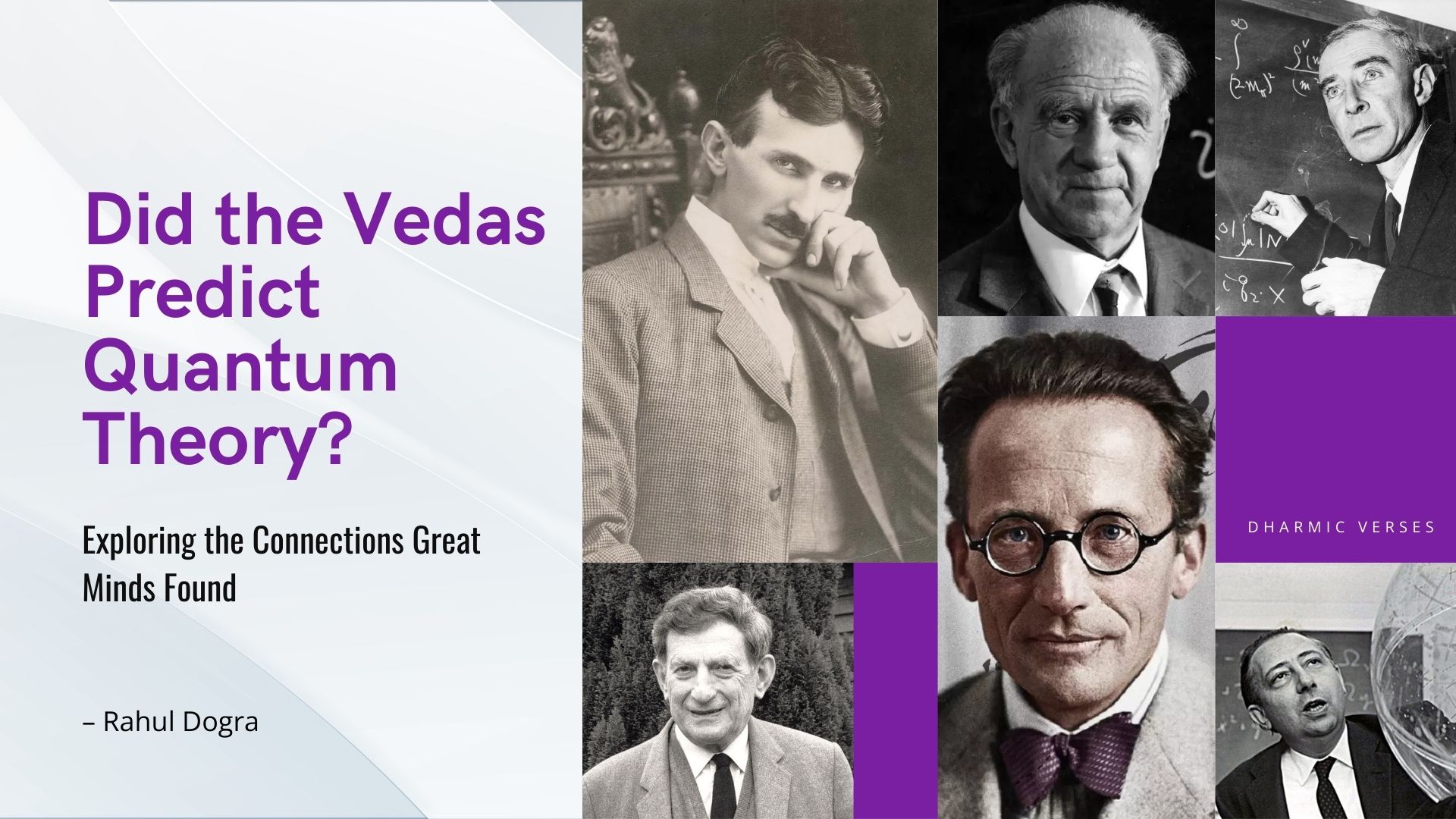

ब्रह्मैवेदं सर्वम्। तत्त्वमसि। अहं ब्रह्मास्मि।
Brahmaivedam sarvam. Tat tvam asi. Aham Brahmasmi.
“All this is indeed Brahman. That thou art. I am Brahman.”
— Mahavakyas from the Upanishads
When Erwin Schrödinger, one of quantum physics’ founding fathers, sat in his Alpine retreat wrestling with the equations that would revolutionize our understanding of reality, he kept a copy of the Upanishads beside him. This wasn’t mere coincidence. The parallels between Vedas and quantum physics have captivated some of history’s greatest scientific minds, leading them to explore ancient Indian wisdom for insights into modern physics’ most perplexing puzzles. Did these ancient seers somehow glimpse truths about the universe that Western science would only discover millennia later? This exploration delves into the fascinating intersections between Vedic knowledge physics and contemporary quantum theory, examining what physicists inspired by Hindu Dharma discovered in these timeless texts.
The relationship between Eastern philosophy science and modern physics represents more than intellectual curiosity. It speaks to fundamental questions about consciousness, reality, and the nature of existence itself. As we examine these connections, we’ll discover that ancient Indian science possessed sophisticated frameworks for understanding reality that resonate remarkably with quantum mechanics’ counterintuitive discoveries.
The Historical Context: When East Met West in Scientific Discourse
The dialogue between Vedic science and modern physics didn’t emerge in a vacuum. During the late 19th and early 20th centuries, Western scholars began seriously engaging with Hindu scriptures and modern science simultaneously experienced revolutionary upheavals. This convergence created fertile ground for cross-pollination of ideas.
Swami Vivekananda’s 1893 appearance at the Parliament of World’s Religions in Chicago marked a watershed moment. His articulation of Vedantic philosophy captured Western intellectual imagination, introducing concepts of universal consciousness and the interconnectedness of all existence to audiences previously unfamiliar with these ideas. Among those profoundly influenced was Nikola Tesla, whose encounters with Swami Vivekananda shaped his thinking about energy and matter.
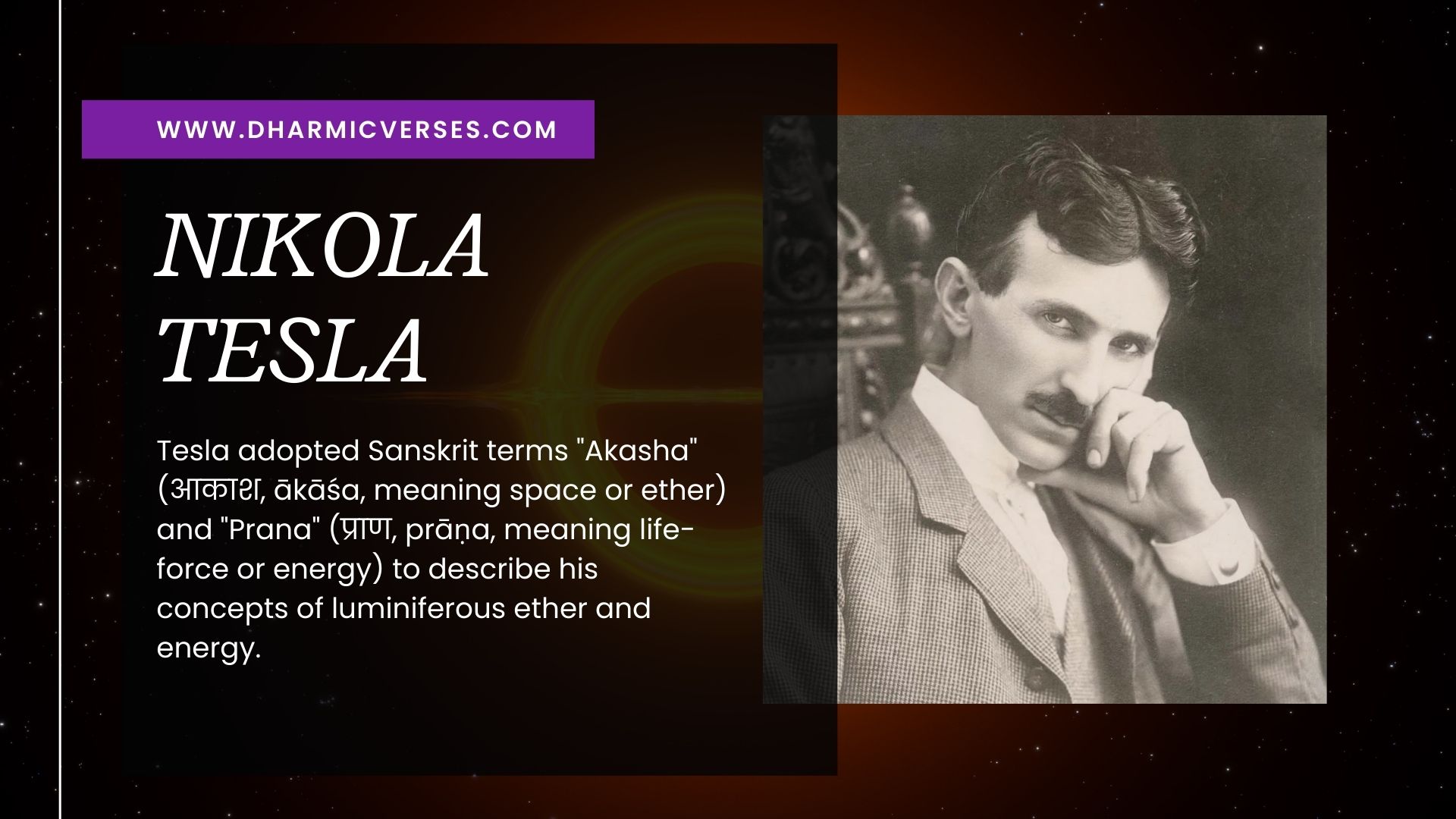
Tesla adopted Sanskrit terms “Akasha” (आकाश, ākāśa, meaning space or ether) and “Prana” (प्राण, prāṇa, meaning life-force or energy) to describe his concepts of luminiferous ether and energy. In correspondence, Tesla wrote about these ancient Indian concepts with genuine reverence, seeing in them a framework that aligned with his intuitions about electromagnetic phenomena. This represents one of the earliest documented instances of Akasha and Prana in physics influencing Western scientific thought.
The quantum revolution that began in the 1920s intensified these cross-cultural exchanges. Physicists confronting the bizarre implications of quantum mechanics—particles existing in superposition, observer effects, non-locality—found themselves grappling with questions that transcended pure mathematics. Many turned to philosophical traditions for interpretive frameworks, and Advaita Vedanta and consciousness studies emerged as particularly relevant.
Schrödinger and Vedanta: A Deep Philosophical Romance
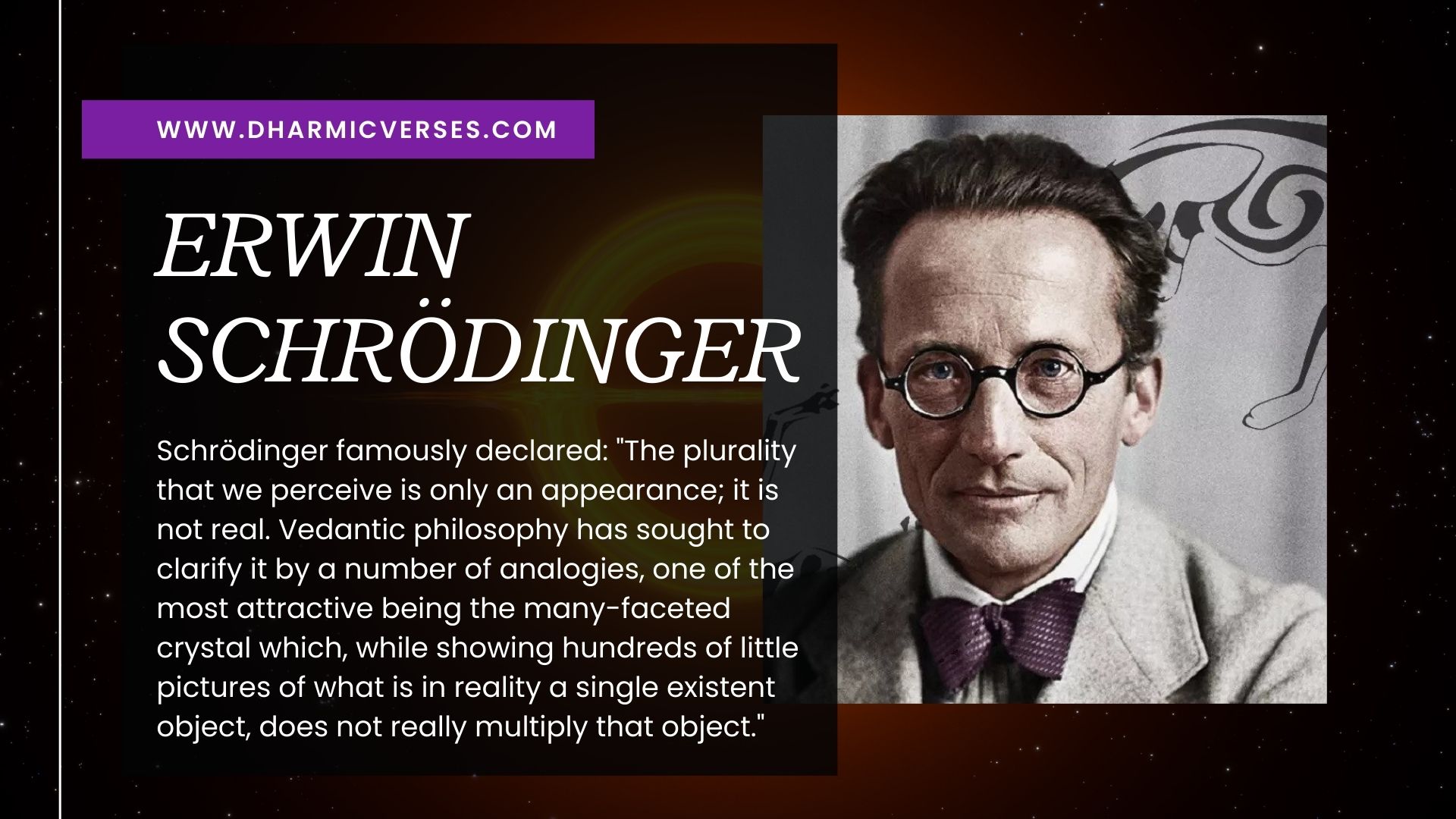
Perhaps no figure better embodies the connection between quantum physics and Vedas than Erwin Schrödinger. The Austrian physicist’s engagement with Vedantic philosophy profoundly shaped his worldview and scientific interpretations. Schrödinger didn’t merely dabble in Eastern philosophy—he studied it seriously, reading the Upanishads in German translation and incorporating their insights into his understanding of quantum mechanics.
Schrödinger famously declared: “The plurality that we perceive is only an appearance; it is not real. Vedantic philosophy has sought to clarify it by a number of analogies, one of the most attractive being the many-faceted crystal which, while showing hundreds of little pictures of what is in reality a single existent object, does not really multiply that object.”
This statement reflects the core Vedantic concept of Maya (माया, māyā, meaning illusion or appearance) and Brahman (ब्रह्मन्, brahman, meaning ultimate reality). According to Advaita Vedanta, the apparent multiplicity of the universe masks an underlying unity. Schrödinger saw direct parallels with quantum mechanics, where seemingly separate particles demonstrate mysterious correlations suggesting deeper interconnection.
In his book “What is Life?”, Schrödinger explored consciousness from a Vedantic perspective, arguing that consciousness is singular—that “I” is a fundamental aspect of the universe rather than a byproduct of neural complexity. He wrote: “Consciousness is never experienced in the plural, only in the singular. Not only has none of us ever experienced more than one consciousness, but there is also no trace of circumstantial evidence of this ever happening anywhere in the world.”
This perspective aligns with the Vedantic teaching of Atman (आत्मन्, ātman, meaning individual soul or self) being identical with Brahman—the famous Mahavakya (महावाक्य, mahāvākya, great saying): “Tat Tvam Asi” (तत् त्वम् असि, tat tvam asi, “That thou art”). Schrödinger’s scientific work thus became inseparable from his philosophical convictions derived from Vedantic study.
The Schrödinger wave equation, his most famous contribution, describes quantum states as probability waves rather than definite particles. This probabilistic nature echoes Vedantic descriptions of reality as neither purely existent nor non-existent but as Mithya (मिथ्या, mithyā, meaning dependent reality)—real from one perspective, unreal from another, always dependent on the underlying Brahman.
Oppenheimer and the Bhagavad Gita: Witnessing the Cosmic Dance![J. Robert Oppenheimer]()
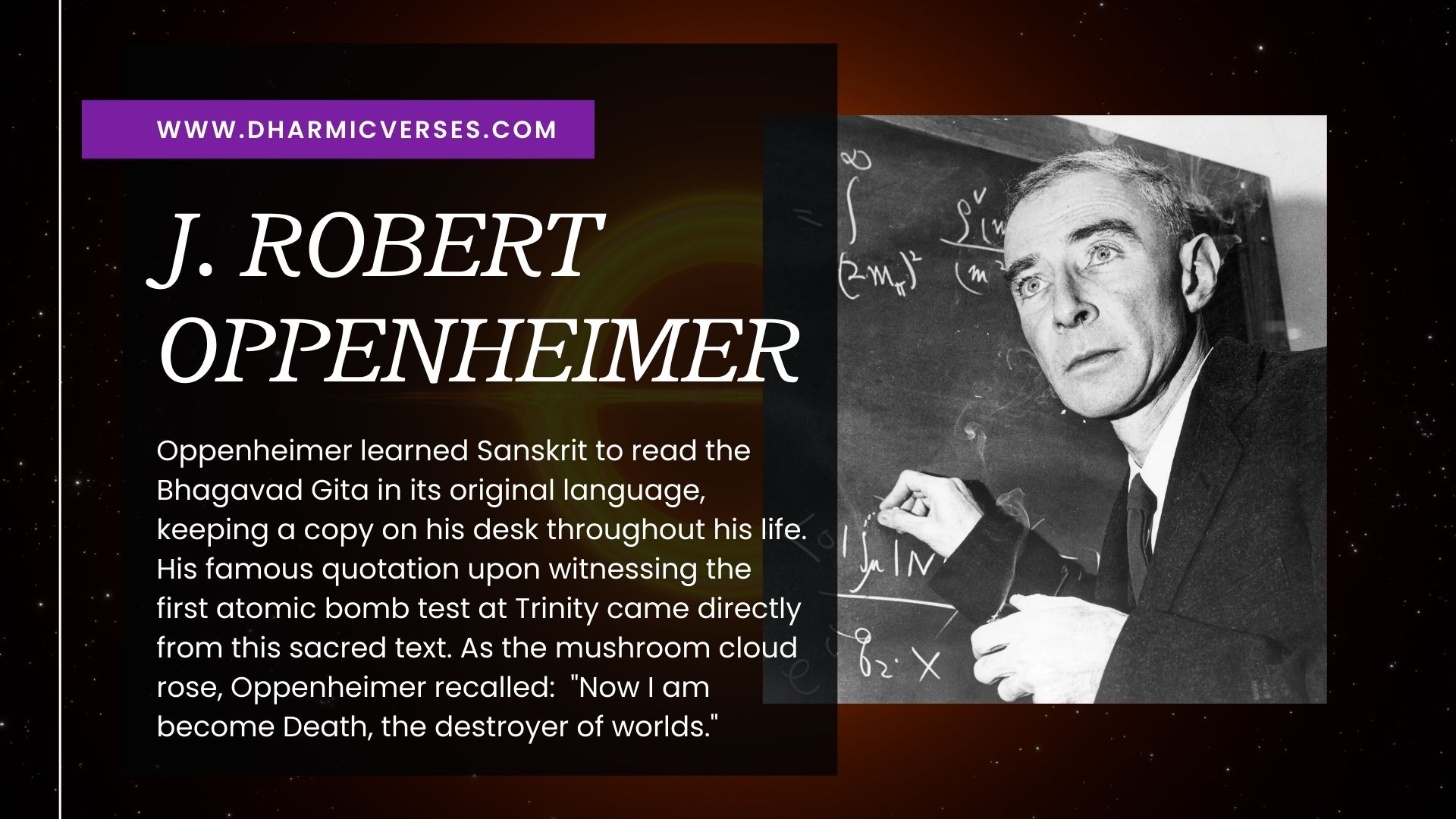
J. Robert Oppenheimer, the “father of the atomic bomb,” represents another towering figure whose engagement with Hindu philosophy profoundly affected his worldview. Unlike Schrödinger’s philosophical interest, Oppenheimer’s encounter with the Bhagavad Gita carried darker, more complex resonances.
Oppenheimer learned Sanskrit to read the Bhagavad Gita in its original language, keeping a copy on his desk throughout his life. His famous quotation upon witnessing the first atomic bomb test at Trinity came directly from this sacred text. As the mushroom cloud rose, Oppenheimer recalled:
कालोऽस्मि लोकक्षयकृत्प्रवृद्धो लोकान्समाहर्तुमिह प्रवृत्तः।
Kālo’smi lokakṣayakṛtpravṛddho lokānsamāhartumih pravṛttaḥ.
“Now I am become Death, the destroyer of worlds.”
— Bhagavad Gita 11.32
This verse comes from the Vishvarupa Darshana (विश्वरूपदर्शन, viśvarūpadarśana, vision of the universal form), where Lord Krishna reveals his cosmic form to Arjuna. The terrifying vision shows the divine as both creator and destroyer, encompassing all existence within a single unified consciousness. Oppenheimer’s invocation of this verse reveals his recognition that atomic weapons represented forces of cosmic magnitude, echoing the Gita’s themes of duty, destruction, and the ultimate nature of reality.
Beyond this famous moment, Oppenheimer found in the Bhagavad Gita a framework for understanding the moral complexities of scientific discovery. The text’s central teaching—performing one’s Dharma (धर्म, dharma, meaning duty, righteousness, cosmic order) without attachment to outcomes—resonated with his struggles regarding weapons development. The Gita’s concept of Nishkama Karma (निष्काम कर्म, niṣkāma karma, action without desire for results) provided, if not comfort, at least a philosophical lens through which to view his role.
The Oppenheimer Bhagavad Gita connection demonstrates how Hindu scriptures provided ethical and metaphysical frameworks for scientists confronting discoveries with profound implications. The Gita’s vision of reality as an interconnected whole where individual actors play predetermined roles within vast cosmic cycles offered a perspective radically different from Western linear conceptions of cause and effect.
Werner Heisenberg and the Limits of Knowledge![Werner Heisenberg]()
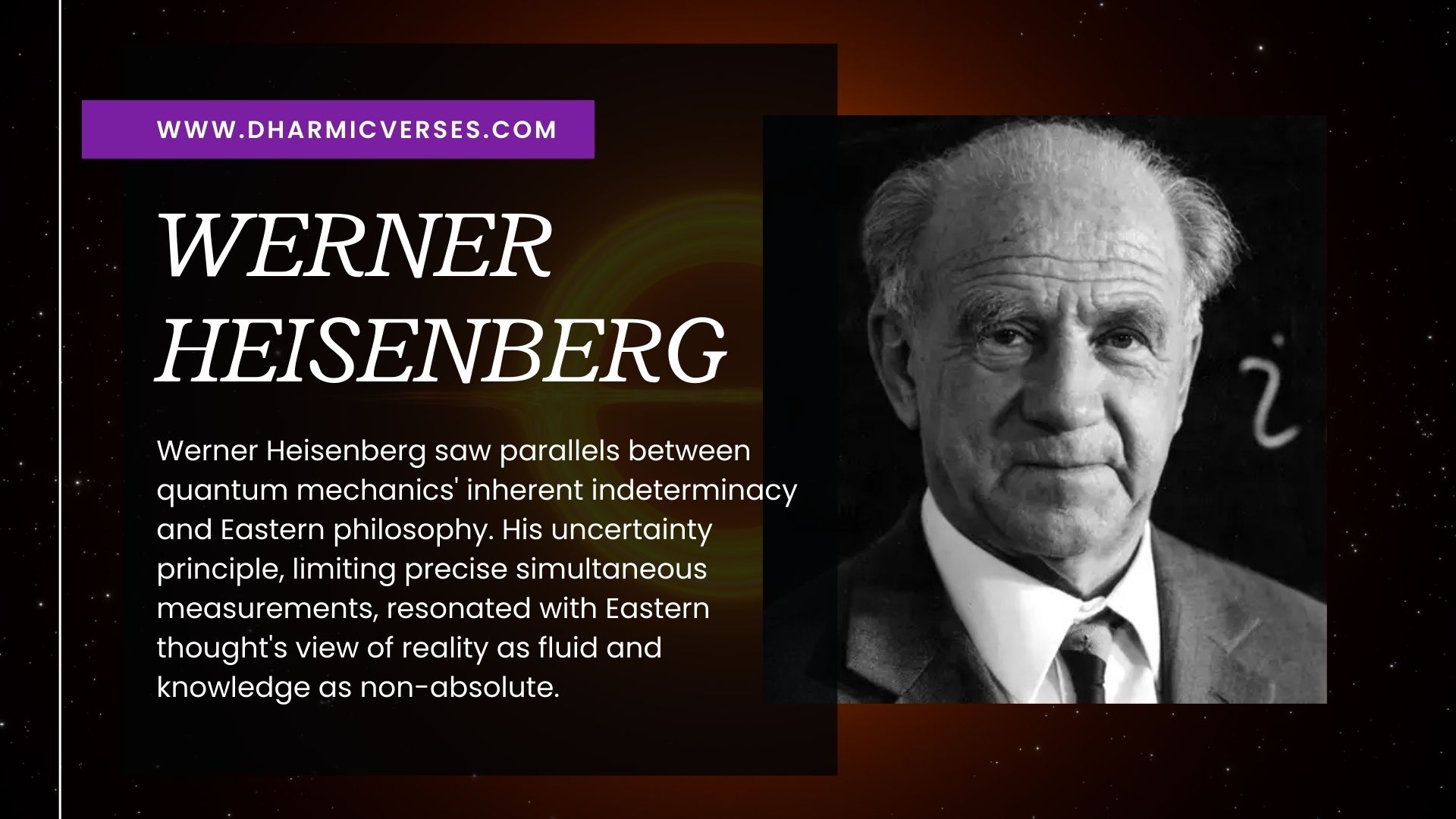
Werner Heisenberg, creator of the uncertainty principle, also engaged deeply with Eastern philosophy, particularly during conversations with Rabindranath Tagore and through his study of Buddhist and Hindu texts. Heisenberg’s uncertainty principle—which states that certain pairs of physical properties cannot be simultaneously known with arbitrary precision—resonated with Eastern philosophical skepticism about absolute knowledge.
In his autobiography, Heisenberg recounted conversations about Indian philosophy, noting parallels between quantum indeterminacy and Eastern conceptions of reality’s fluid, non-absolute nature. The Werner Heisenberg Eastern philosophy connection centered on epistemological questions: What can we know? How do our observations affect what we observe?
The Nasadiya Sukta (नासदीय सूक्त, nāsadīya sūkta, Creation Hymn) from the Rig Veda (10.129) expresses profound uncertainty about cosmic origins:
नासदासीन्नो सदासीत्तदानीं नासीद्रजो नो व्योमा परो यत्।
Nāsadāsīnno sadāsīttadānīṁ nāsīdrajo no vyomā paro yat.
“Then even nothingness was not, nor existence. There was no air then, nor the heavens beyond it.”
This ancient verse acknowledges fundamental limits to knowledge about ultimate origins—a humility that resonates with quantum mechanics’ demonstration that nature imposes fundamental limits on what can be known simultaneously. The observer effect in Vedas finds expression in various contexts where consciousness and perception shape experienced reality.
Heisenberg noted that quantum mechanics forced physicists to abandon the objective, observer-independent reality assumed in classical physics. Similarly, Vedantic philosophy teaches that the observer (the Drashta द्रष्टा, draṣṭā) and observed (the Drishya दृश्य, dṛśya) aren’t truly separate but arise together within consciousness.
The Observer Effect: Consciousness Collapses the Wave Function
One of quantum mechanics’ most philosophically troubling aspects is the measurement problem. Before observation, quantum systems exist in superposition—simultaneously in multiple states. Upon measurement, this superposition “collapses” into a definite state. But what constitutes observation? Does consciousness play a fundamental role?
These questions led several physicists to explore consciousness quantum mechanics connections, finding surprising resonances with Vedantic teachings. In Advaita Vedanta, consciousness (Chit चित्, cit) isn’t an emergent property of matter but the fundamental substrate of reality. The material world arises within consciousness, not the reverse.
The Yoga Vashishtha, an ancient philosophical text, describes reality as Chidakasha (चिदाकाश, cidākāśa, the space of consciousness), within which all phenomena appear like waves on an ocean. This metaphor remarkably parallels quantum field theory, where particles emerge as excitations in underlying fields.
Physicist John Wheeler’s “participatory universe” concept—that observers aren’t passive recipients of information but active participants in creating reality—echoes Vedantic teachings about the creative role of consciousness. The famous Drg-Drishya Viveka (दृग्-दृश्य विवेक, dṛg-dṛśya viveka, discrimination between seer and seen) teaches that reality emerges through the interaction of consciousness with its objects.
The Mandukya Upanishad presents a sophisticated analysis of consciousness through four states: waking (Jagrat जाग्रत्, jāgrat), dreaming (Svapna स्वप्न, svapna), deep sleep (Sushupti सुषुप्ति, suṣupti), and the transcendent fourth state (Turiya तुरीय, turīya). This framework suggests reality possesses different levels or layers, not unlike quantum mechanics’ description of underlying quantum fields giving rise to observed classical reality.
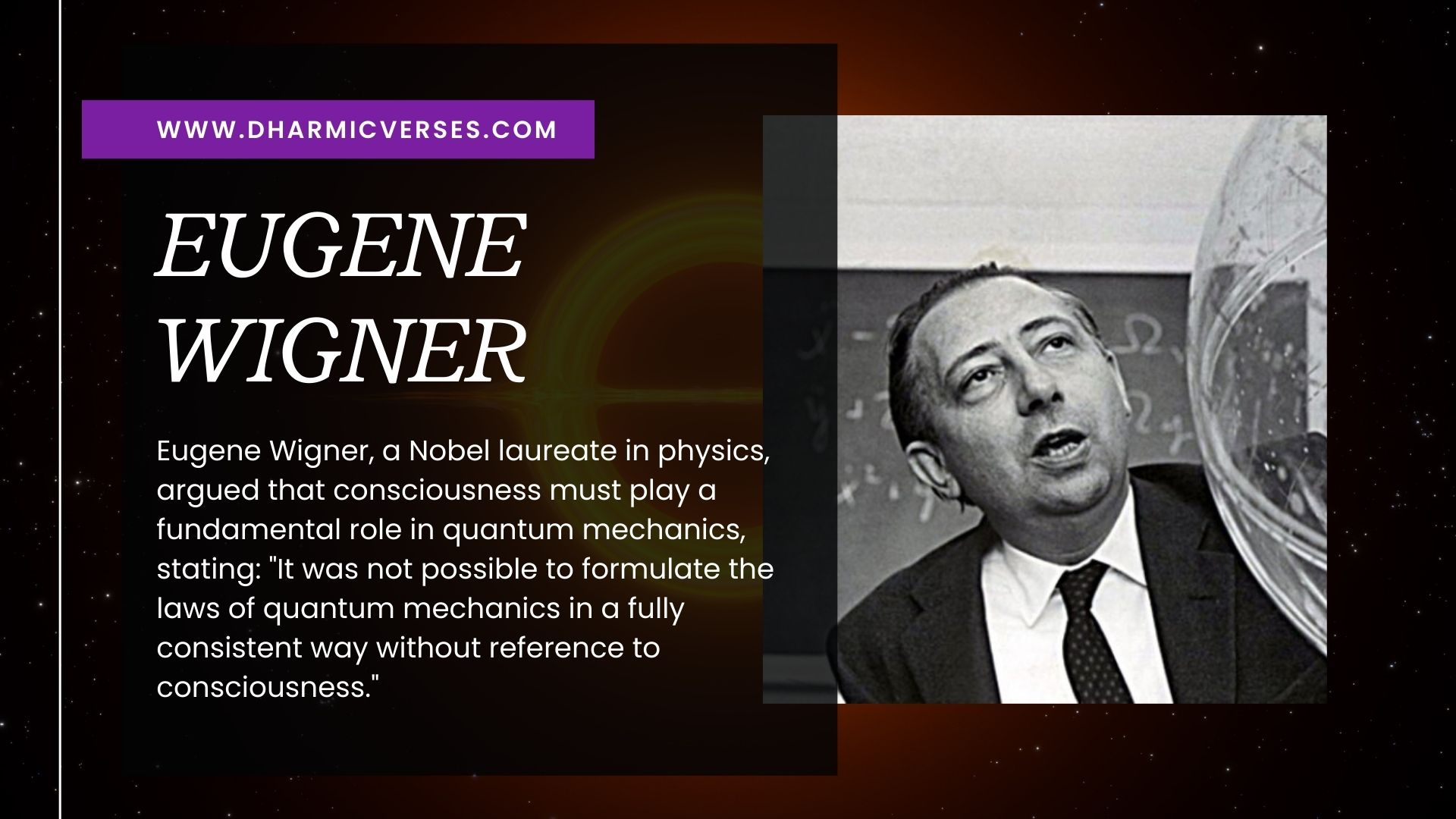
Eugene Wigner, a Nobel laureate in physics, argued that consciousness must play a fundamental role in quantum mechanics, stating: “It was not possible to formulate the laws of quantum mechanics in a fully consistent way without reference to consciousness.” This position, while controversial among physicists, aligns with universal consciousness teachings found throughout Hindu philosophy.
Non-Duality in Quantum Mechanics: The End of Separateness
Perhaps the deepest connection between quantum physics and Vedas lies in their shared rejection of fundamental separateness. Quantum entanglement demonstrates that particles once in contact remain mysteriously correlated regardless of distance—Einstein’s “spooky action at a distance.” Measurements on one entangled particle instantaneously affect its partner, suggesting an underlying non-local connection.
This quantum non-locality resonates powerfully with Advaita (अद्वैत, advaita, non-duality), the philosophical position that ultimate reality is non-dual—not two, but one without a second. The apparent separateness of objects and beings represents Vyavaharika (व्यवहारिक, vyāvahārika, conventional or empirical) reality, valid for practical purposes but not ultimately true from the Paramarthika (पारमार्थिक, pāramārthika, absolute) perspective.
The Isha Upanishad opens with a verse expressing this unity:
ईशावास्यमिदं सर्वं यत्किञ्च जगत्यां जगत्।
Īśāvāsyamidaṁ sarvaṁ yatkiñca jagatyāṁ jagat.
“The Lord pervades all this—whatever moves in this moving world.”
This teaching that divine consciousness pervades everything parallels quantum field theory’s description of fields extending throughout space, with particles as localized excitations. The non-duality in quantum mechanics appears when we recognize that seemingly separate particles emerge from unified quantum fields, just as Advaita teaches that apparently separate beings arise from unified Brahman.
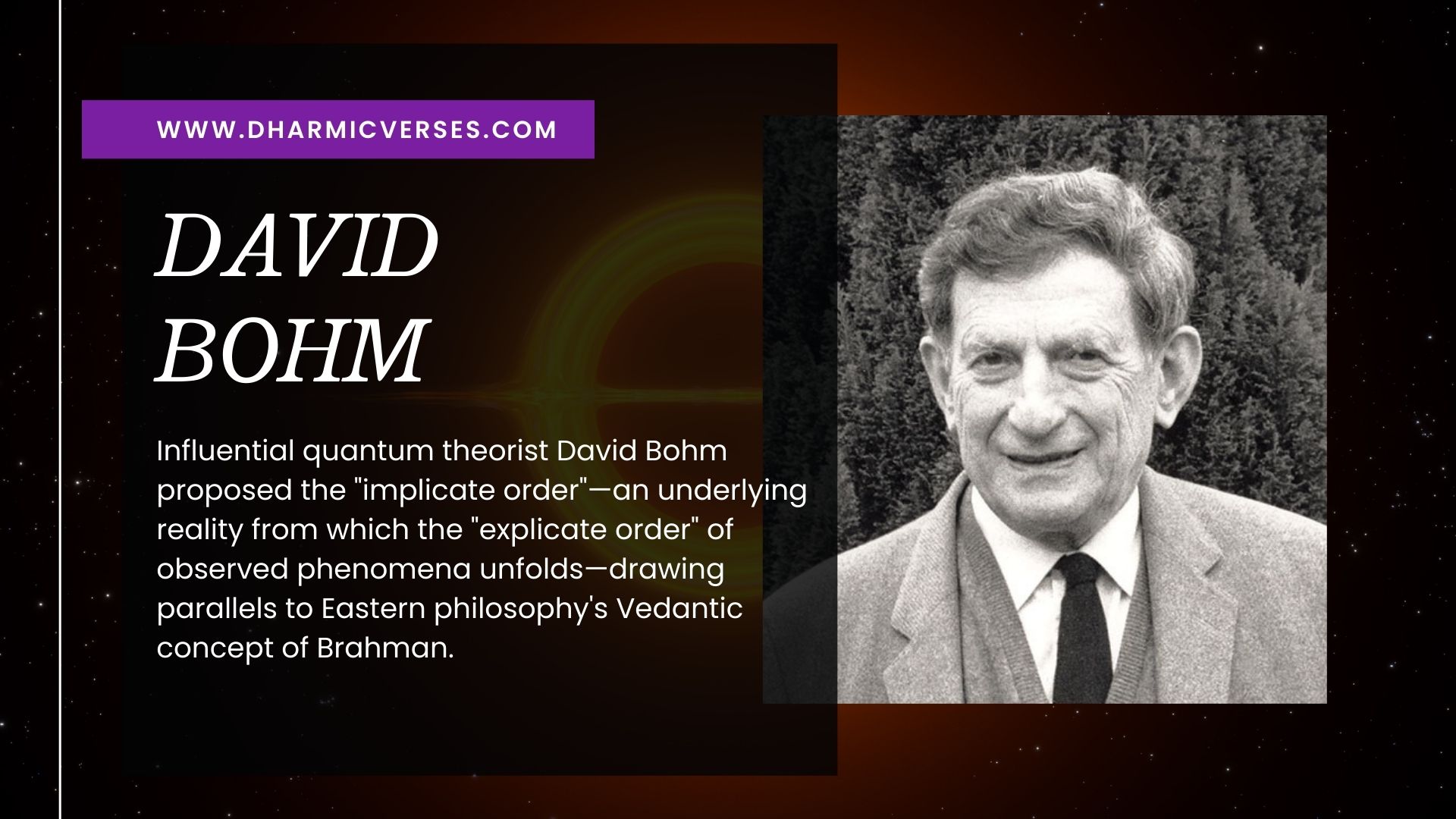
David Bohm, whose work on quantum theory’s interpretation influenced generations of physicists, developed the concept of “implicate order”—an underlying, enfolded reality from which the “explicate order” of observed phenomena unfolds. Bohm explicitly drew connections to Eastern philosophy, particularly the Vedantic concept of Brahman as the unmanifest ground from which manifest reality emerges.
The Brahman and unified field theory connection represents more than metaphorical similarity. Both point to a unified foundation underlying apparent multiplicity. String theory and other contemporary physics approaches seeking a “theory of everything” pursue mathematical descriptions of this unity that ancient seers approached through contemplative insight.
Vedic Cosmology and Modern Physics: Cycles of Creation
The cyclical nature of Vedic cosmology and Big Bang theory presents another intriguing parallel. While modern cosmology describes a universe with a definite beginning (the Big Bang) and possible ending (heat death or Big Crunch), it increasingly considers cyclic models where universes undergo endless cycles of expansion and contraction.
Vedic cosmology describes vast cosmic cycles called Kalpas (कल्प, kalpa). One Kalpa equals 4.32 billion years—remarkably close to Earth’s actual age. The Puranas describe these cycles as the day and night of Brahma (ब्रह्मा, brahmā, the creator deity), during which universes emerge, exist, and dissolve, only to emerge again.
The Vishnu Purana states:
कल्पादौ सृज्यते विश्वं कल्पान्ते लयमेति च।
Kalpādau sṛjyate viśvaṁ kalpānte layameti ca.
“At the beginning of a Kalpa, the universe is created; at the end of a Kalpa, it dissolves.”
This cyclical conception finds echoes in contemporary cosmological models like conformal cyclic cosmology, proposed by Roger Penrose, which suggests our universe may be one in an infinite sequence of universes, each emerging from the death of its predecessor.
The Vedic concept of Pralaya (प्रलय, pralaya, cosmic dissolution) describes how the universe periodically returns to an undifferentiated state before manifesting again. This resembles modern physics’ descriptions of false vacuum decay or quantum fluctuations potentially triggering new cosmic epochs.
Ancient Indian texts also describe multiple simultaneous universes. The Bhagavata Purana speaks of countless Brahmandas (ब्रह्माण्ड, brahmāṇḍa, cosmic eggs or universes) floating in the infinite Karana Sagara (कारण सागर, kāraṇa sāgara, causal ocean). This multiverse conception predates by millennia contemporary physics’ consideration of multiple universes arising from eternal inflation or quantum mechanical branching.
The Five Elements and Fundamental Forces
The Vedic conception of Pancha Mahabhuta (पञ्च महाभूत, pañca mahābhūta, five great elements)—earth, water, fire, air, and ether—represents more than primitive proto-chemistry. These categories describe fundamental qualities and forces rather than literal chemical elements.
Akasha (आकाश, ākāśa, ether or space) particularly intrigues physicists. Described as the subtlest element, the matrix within which all others manifest, Akasha resembles modern concepts of the quantum vacuum—not empty nothingness but a seething ocean of virtual particles and fields from which observed phenomena emerge.
The Taittiriya Upanishad (2.1.1) describes creation proceeding from Akasha:
तस्माद्वा एतस्मादात्मन आकाशः सम्भूतः।
Tasmādvā etasmādātmana ākāśaḥ sambhūtaḥ.
“From that Self, indeed, Akasha was born.”
This sequence—Brahman (consciousness) giving rise to Akasha (space), from which emerge other elements—parallels contemporary physics’ understanding that space-time isn’t a passive container but an active participant in physical processes, with quantum fields pervading it.
The Vedic Prana concept extends beyond mere breath to encompass subtle energies pervading the cosmos. Some researchers have drawn parallels between Prana and zero-point energy or quantum fields, though such comparisons require caution against superficial equivalences.
The Prasna Upanishad explores Prana’s cosmic role, describing it as the fundamental life-principle animating all existence. While modern physics doesn’t recognize “life-force” as a fundamental interaction, the concept of energy fields pervading space—electromagnetic, gravitational, nuclear—shares structural similarities with Vedic energy concepts.
Time, Causality, and the Eternal Now
Quantum mechanics’ treatment of time creates profound interpretive challenges. The equations work equally well forward or backward in time, suggesting time’s arrow emerges from entropy increase rather than being fundamental. Experiments demonstrating retrocausality (where measurements appear to affect past events) further complicate temporal understanding.
Vedantic philosophy presents sophisticated analyses of time’s nature. The Yoga Vashishtha teaches that past, present, and future coexist in the eternal present of consciousness. From Brahman’s perspective, time represents Maya—a construct of limited perception rather than ultimate reality.
The Bhagavad Gita presents Krishna’s cosmic form containing all time:
पश्य मे पार्थ रूपाणि शतशोऽथ सहस्रशः।
Paśya me pārtha rūpāṇi śataśo’tha sahasraśaḥ.
“Behold, O Partha, My forms by hundreds and thousands.”
— Bhagavad Gita 11.5
This vision reveals all events—past, present, and future—existing simultaneously within divine consciousness. Block universe theories in modern physics similarly suggest all moments in time exist equally, with the flow of time being an illusion of consciousness moving through a four-dimensional space-time.
Carlo Rovelli’s relational quantum mechanics and Julian Barbour’s timeless physics echo Vedantic teachings that time emerges from relationships and changes rather than being a fundamental container. The Sanskrit term Kala (काल, kāla, time) also means “death” and “that which devours,” suggesting time’s relative, destructive nature rather than absolute existence.
The Limits of Comparison
While exploring connections between quantum physics and Vedas proves fascinating, intellectual honesty demands acknowledging significant differences and avoiding superficial equivalences. The Vedas weren’t scientific textbooks, and their primary purpose wasn’t predicting physical theories but providing frameworks for spiritual realization and liberation (Moksha मोक्ष, mokṣa).
Ancient seers employed different methodologies than modern scientists. Rishis (ऋषि, ṛṣi, seers) relied on direct contemplative insight (Aparoksha Anubhuti अपरोक्ष अनुभूति, aparokṣa anubhūti) rather than controlled experimentation and mathematical formalization. Their descriptions used poetic, metaphorical language rather than precise technical terminology.
Claims that “ancient Indians invented quantum mechanics” or “the Vedas contain all scientific knowledge” disrespect both traditions—diminishing the Vedas’ spiritual depth by reducing them to proto-science while minimizing quantum mechanics’ revolutionary nature and the intellectual struggles required to develop it.
The valuable insight isn’t that Vedic seers somehow anticipated specific quantum mechanical equations. Rather, both traditions—contemplative philosophy and experimental physics—converged on fundamental insights about reality’s nature: interconnectedness, the role of observation, the limits of objective knowledge, and the mysterious relationship between consciousness and matter.
What Physicists Actually Found in Hindu Dharma
The physicists inspired by Hindu Dharma didn’t simply discover confirmation of modern theories in ancient texts. Their engagement proved more subtle and profound. They found:
Conceptual Frameworks: When quantum mechanics shattered classical assumptions about objective reality, Hindu philosophy offered alternative frameworks for thinking about consciousness, observation, and reality’s nature. These weren’t predictions but parallel insights arrived at through different means.
Philosophical Comfort: The counterintuitive nature of quantum mechanics—superposition, entanglement, observer effects—troubled many physicists trained in classical determinism. Eastern philosophy’s long engagement with paradox, complementarity, and the limits of conceptual thought provided intellectual resources for navigating quantum strangeness.
Humility About Knowledge: Both traditions recognize fundamental limits to knowledge. Heisenberg’s uncertainty principle mathematically formalized limitations, while Vedantic epistemology had long taught that ultimate reality transcends conceptual understanding, accessible only through direct experience.
Unity Beneath Diversity: Perhaps most significantly, both quantum mechanics and Vedantic philosophy point toward underlying unity despite surface diversity. Whether described as quantum fields, unified theories, or Brahman, both traditions suggest that separateness is less fundamental than connection.
The Role of Consciousness: While Western philosophy largely treated consciousness as a byproduct of matter, Vedantic philosophy placed it as fundamental. As quantum mechanics forced reconsideration of observation’s role, some physicists found the Vedantic perspective worth serious consideration.
Modern Applications and Ongoing Research
Contemporary researchers continue exploring intersections between ancient Indian wisdom and modern physics, though with greater methodological rigor than early enthusiasts. Quantum information science, studying how quantum systems process information, has led some researchers to examine classical Indian logic (Nyaya न्याय, nyāya) and epistemology for insights.
Studies of meditation’s effects on consciousness have employed quantum theoretical frameworks, examining whether quantum processes in neural microtubules might explain consciousness—the controversial Orch-OR theory proposed by Roger Penrose and Stuart Hameroff. While speculative, such research demonstrates ongoing dialogue between contemplative traditions and cutting-edge physics.
The field of quantum biology investigates quantum effects in living systems—photosynthesis, bird navigation, enzyme catalysis. Some researchers draw parallels with Ayurvedic and Yogic concepts of subtle energy systems, though such connections remain highly speculative.
Cosmological research continues finding surprising resonances with Vedic cyclic models. The concept of cosmic inflation, where the universe underwent exponential expansion fractions of a second after the Big Bang, shares structural similarities with Vedic descriptions of rapid cosmic manifestation from unmanifest potential.
Implications for Understanding Reality
What emerges from examining connections between Vedic knowledge physics and quantum theory isn’t vindication of either tradition over the other but recognition that humans have long grappled with fundamental questions about existence through different methodological approaches.
Science proceeds through hypothesis, experimentation, mathematical formalization, and empirical verification. This methodology has proven extraordinarily powerful for understanding physical phenomena and developing technologies. Yet it faces inherent limitations when addressing questions of meaning, purpose, consciousness, and subjective experience.
Contemplative traditions, including Vedantic philosophy, approach reality through systematic introspection, meditation, and direct investigation of consciousness itself. They’ve developed sophisticated frameworks for understanding subjective experience, ethics, and the nature of mind that complement rather than contradict scientific approaches.
The most fruitful perspective recognizes both traditions as legitimate ways of knowing, each illuminating aspects of reality the other may miss. Quantum mechanics reveals the mathematical structure of physical interactions; Vedanta explores the nature of the knower experiencing those interactions. Neither captures reality completely; together, they offer richer understanding.
This integrative approach avoids both scientific reductionism (claiming all knowledge reduces to physics) and religious dogmatism (claiming ancient texts contain all truth). Instead, it embraces epistemic humility—recognizing that reality’s fullness likely exceeds any single framework’s capacity to capture it.
Vedas and Quantum Physics: The Continuing Journey
The dialogue between Eastern philosophy science and modern physics remains very much alive. As physics pushes deeper into reality’s foundations—exploring quantum gravity, consciousness, cosmological origins—philosophical questions become unavoidable. Mathematical equations alone cannot determine their interpretation or meaning.
Similarly, as contemplative practices like meditation and yoga gain scientific legitimacy through neuroscience and psychology research, practitioners increasingly recognize value in empirical investigation of traditional claims about consciousness and wellbeing.
The scientists who found inspiration in Hindu Dharma weren’t abandoning scientific rigor for mysticism. They were recognizing that science addresses “how” questions while philosophy addresses “what” and “why” questions—and both are necessary for comprehensive understanding.
Future developments may strengthen these connections. Quantum computing’s development forces reconsideration of information’s nature and consciousness’s potential role. Advances in neuroscience investigating meditation’s effects may reveal measurable correlates of traditional descriptions of consciousness states. Cosmological discoveries about the universe’s ultimate fate or potential multiverse nature may resonate with ancient cyclic models.
Yet we should remain cautious about claiming ancient texts predicted modern discoveries. The value lies not in prediction but in recognition that profound truths about existence can be approached from multiple angles—experimental investigation and contemplative insight both offering valid perspectives on reality’s nature.
Practical Wisdom for Modern Seekers
For contemporary readers interested in both modern science ancient texts and spiritual development, several practical lessons emerge from this exploration:
Intellectual Humility: Neither science nor religion possesses complete truth. Remaining open to insights from diverse traditions enriches understanding while avoiding dogmatism.
Direct Experience: Both quantum physicists and Vedantic practitioners emphasize direct investigation over mere belief. Experiment with meditation and contemplative practices to explore consciousness directly rather than only conceptually.
Integration Not Opposition: Science and spirituality needn’t conflict. They address different questions through different methods. Integrate both for fuller understanding rather than choosing sides.
Respect for Complexity: Avoid simplistic equivalences like “quantum physics proves Vedanta” or “ancient Indians knew everything.” Reality’s complexity deserves more nuanced engagement.
Practical Application: The Vedic tradition emphasizes Sadhana (साधना, sādhana, spiritual practice) over mere intellectual understanding. Apply insights through meditation, ethical living, and self-inquiry rather than only studying concepts.
The Mundaka Upanishad distinguishes between Para Vidya (परा विद्या, parā vidyā, higher knowledge leading to liberation) and Apara Vidya (अपरा विद्या, aparā vidyā, lower knowledge of worldly phenomena). Science excels at Apara Vidya—understanding nature’s workings. Contemplative traditions offer Para Vidya—understanding one’s true nature beyond phenomenal appearances. Both have value; neither substitutes for the other.
Bridging Two Ways of Knowing
The exploration of connections between Vedas and quantum physics reveals something profound about human knowledge-seeking. Across millennia and cultures, the deepest thinkers have arrived at remarkably similar insights about reality’s nature: that apparent separateness masks underlying unity, that consciousness plays a fundamental role in existence, that reality transcends simple categories of existence and non-existence.
These convergences don’t prove that ancient seers possessed scientific knowledge in the modern sense. Rather, they demonstrate that reality itself possesses certain fundamental characteristics that become apparent whether approached through mathematical physics or contemplative philosophy. The universe’s interconnectedness, the mysterious nature of consciousness, the limits of objective knowledge—these truths emerge from both traditions because they reflect reality’s actual structure.
For those physicists inspired by Hindu Dharma—Schrödinger, Oppenheimer, Heisenberg, and others—the ancient wisdom provided not scientific theories but philosophical frameworks for interpreting their discoveries’ meaning. It offered language and concepts for discussing aspects of reality that mathematics alone couldn’t capture.
The ongoing dialogue between modern science ancient texts enriches both traditions. Science gains philosophical depth and interpretive frameworks beyond pure mathematics. Ancient philosophy gains empirical grounding and testability through scientific investigation. Neither tradition need abandon its methodology or core insights; instead, they complement each other in humanity’s endless quest to understand existence.
As we continue exploring reality’s foundations—whether through particle accelerators or meditation cushions, mathematical equations or sacred verses—we might remember that truth reveals itself through many pathways. The physicist’s laboratory and the sage’s cave represent different approaches to the same ultimate questions. Both deserve respect; both offer insights; both remain incomplete alone.
ॐ पूर्णमदः पूर्णमिदं पूर्णात्पूर्णमुदच्यते।
पूर्णस्य पूर्णमादाय पूर्णमेवावशिष्यते॥Om pūrṇamadaḥ pūrṇamidaṁ pūrṇātpūrṇamudacyate.
Pūrṇasya pūrṇamādāya pūrṇamevāvaśiṣyate.“That is whole, this is whole. From wholeness emerges wholeness.
Wholeness coming from wholeness, wholeness still remains.”— Isha Upanishad, Invocation
This ancient verse captures a profound truth that quantum field theory would express mathematically millennia later: that infinity minus infinity remains infinity, that the quantum vacuum can produce particles without depleting itself, that wholeness pervades reality at every scale. Whether we call this wholeness Brahman or the unified field, whether we approach it through Sanskrit verses or Schrödinger equations, we’re pointing toward the same mysterious, magnificent reality that contains and transcends us all.

Comments are closed.