
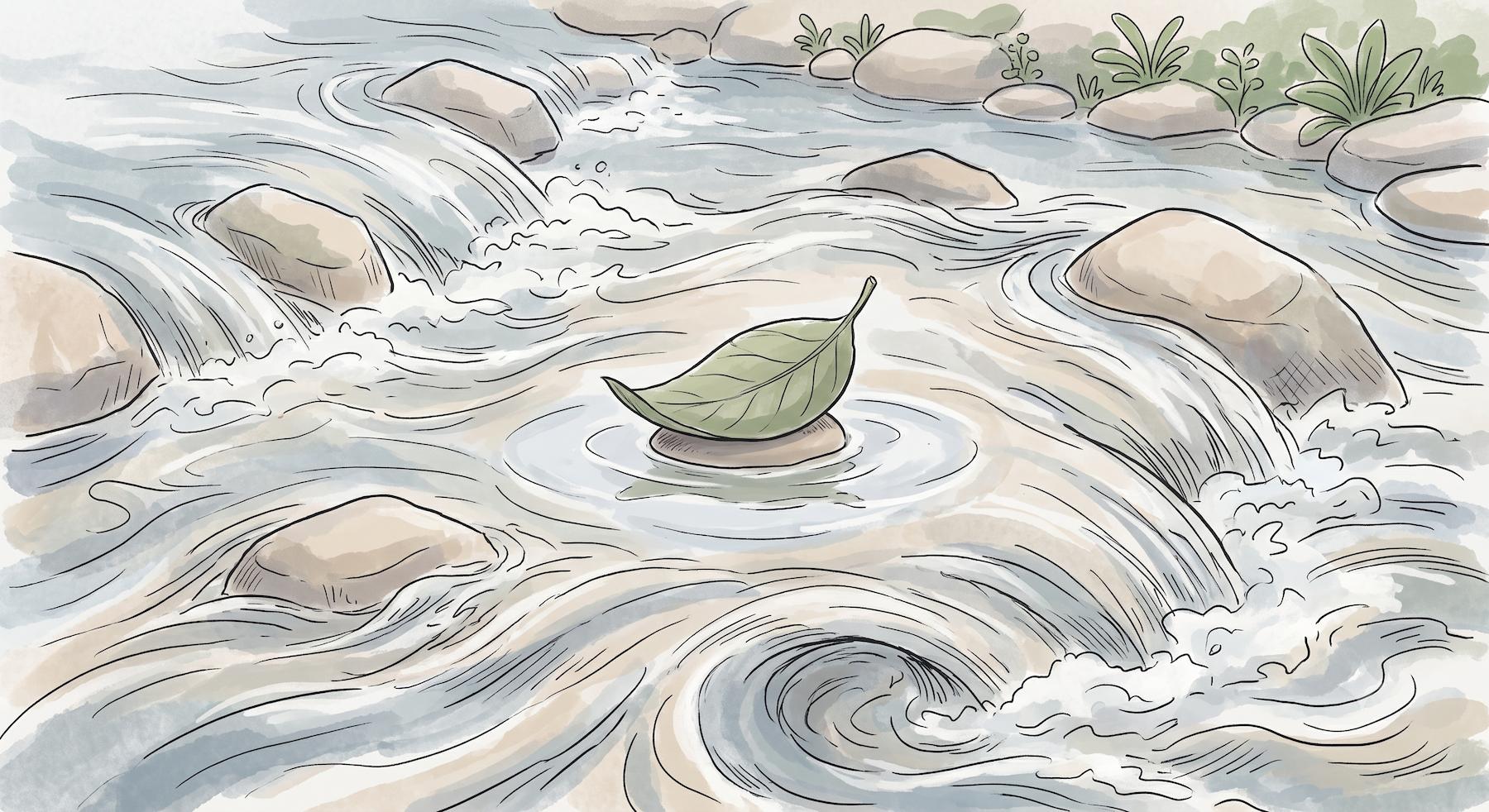
He Is Time, and He Is Beyond It
unmoved at the center of everything that moves

There is a clock running inside every single thing that lives.
The leaf unfurling on a branch, the child growing taller than their own doorframe, the wrinkle finding its way to a face that used to be smooth — all of it moving forward on the same invisible current, none of it able to pause even for a moment to catch its breath.
We call this current time. Most of us spend our whole lives either racing it or hiding from it, rarely stopping to ask what it actually is, or who, if anyone, is holding the clock.
The Atharvashiras Upanishad gives an answer that startled me the first time I sat with it properly.
Rudra — Shiva — is named there as Kala itself. Time. Not merely present within time the way we are. Time, in its entirety, wearing his name.
And in the very same breath, the text insists he remains untouched by it.
The God Who Is the Clock
Most of the old texts are careful to place the divine somewhere above time — eternal, unaging, watching the centuries pass the way you might watch weather through a window, present but unaffected.
Shiva is not described this way here.
He is not merely watching time pass. He is the passing. The Atharvashiras does not hesitate to name him Kala directly — the force that ages the mountain, wears down the river stone, calls every living thing forward toward its own ending without exception, without apology, without ever once slowing down for anyone who begs it to.
This is a harder image to sit with than the gentler pictures we usually reach for. It would be easier, in some ways, if Shiva simply stood outside of time, protecting us from it.
Instead, the text tells us he is the thing doing the aging. He is the reason nothing stays the way it was yesterday.
And Yet — Beyond It
Here is where the teaching turns, and turns sharply.
The very same texts that name him Kala also insist, without contradiction, that he remains Mahakala — time beyond time, the one who is not caught inside the current even though the current itself carries his name.
I used to find this confusing, as though the texts were trying to have it two ways at once. I don’t think that anymore.
I think they are pointing at something most of us have actually felt, at least once, without having language for it.
There is a difference between the clock and the one who built the clock. Between the river and the riverbed that shapes where the river is allowed to flow. Between the changing and whatever it is that notices the changing, unmoved, the way a mirror is not disturbed by whatever passes in front of it.
Shiva as Kala is the current that ages everything. Shiva as Mahakala is the stillness the current moves through — present at the exact center of the motion, and yet somehow never swept along by it.
Living Inside the Clock, Touching the Timeless
I think this is worth sitting with honestly, because most of us live entirely on one side of this teaching.
We live, almost all the time, inside the clock. Inside deadlines and birthdays and the quiet dread of another year passing faster than the one before it. Inside the grief of watching people we love age, and the harder grief of noticing our own reflection doing the same thing.
This is not a mistake. This is simply what it means to have a body, a calendar, a life measured in mornings.
But the Upanishad is not asking you to escape the clock. It is naming something quieter, available in the exact same moment you’re living inside time’s current: that there is a part of you, right now, that is not actually being carried along by it.
You have felt this before, even if you didn’t have a name for it. In deep sleep, where no time seems to pass at all, even though the clock on the wall insists eight hours went by. In the strange stillness that sometimes arrives in the middle of grief, where for one unexplainable moment, the loss and the love feel like the same eternal thing, untouched by whatever day it happens to be. In meditation, when the breath slows enough that the mind briefly stops counting anything at all.
These are not escapes from time. They are glimpses of Mahakala, sitting quietly at the center of Kala, the way stillness sits at the exact middle of a spinning wheel — closest to the motion of anything on the wheel, and yet moving the least of anywhere on it.
Why This Matters When You’re Afraid of Aging
I think this teaching is quietly, specifically, for anyone who has ever lain awake afraid of getting older. Afraid of a birthday. Afraid of how fast a decade seems to have gone.
The fear makes complete sense if you believe you are only the part of yourself that lives inside Kala — the body, the face in the mirror, the years accumulating whether you’re ready for them or not.
But the same texts that name Shiva as time also insist you carry something of Mahakala within you too — not instead of the aging body, alongside it. Something that was not born when your body was born, and will not end when your body ends.
This does not make the aging painless. Shiva as Kala does not stop taking what he takes. The wrinkle still arrives. The years still go.
But it does mean the fear does not have to be the whole story. There is a part of you old texts insist was never running on the same clock as your face — quietly present the entire time, unbothered by the hour, the way Mahakala sits unmoved at the exact center of the current he himself set in motion.
A Small Practice
The next time you feel time pressing on you — a birthday that stings more than it should, a deadline crowding your chest, the quiet grief of noticing how fast a season went —
Pause. Breathe in slowly. Breathe out slower.
Ask, gently, not as a way of escaping the moment, but as a way of widening it: what in me is not actually moving right now?
Not your thoughts. Not your breath, even, which is still rising and falling. Something underneath both of those. The witnessing itself. The part that notices the clock without being run by it.
You do not have to find a dramatic answer. Just the asking, held for a few honest breaths, is often enough to remember that you are not only Kala’s passenger.
Something in you has always been sitting closer to Mahakala than you knew.
May you carry both truths gently — the current that ages you, and the stillness at its exact center that never has. And may the fear of time loosen its grip, just slightly, the moment you remember you were never only the passenger.
Om Namah Shivaya.
— The Wise Monster
Comments are closed.