
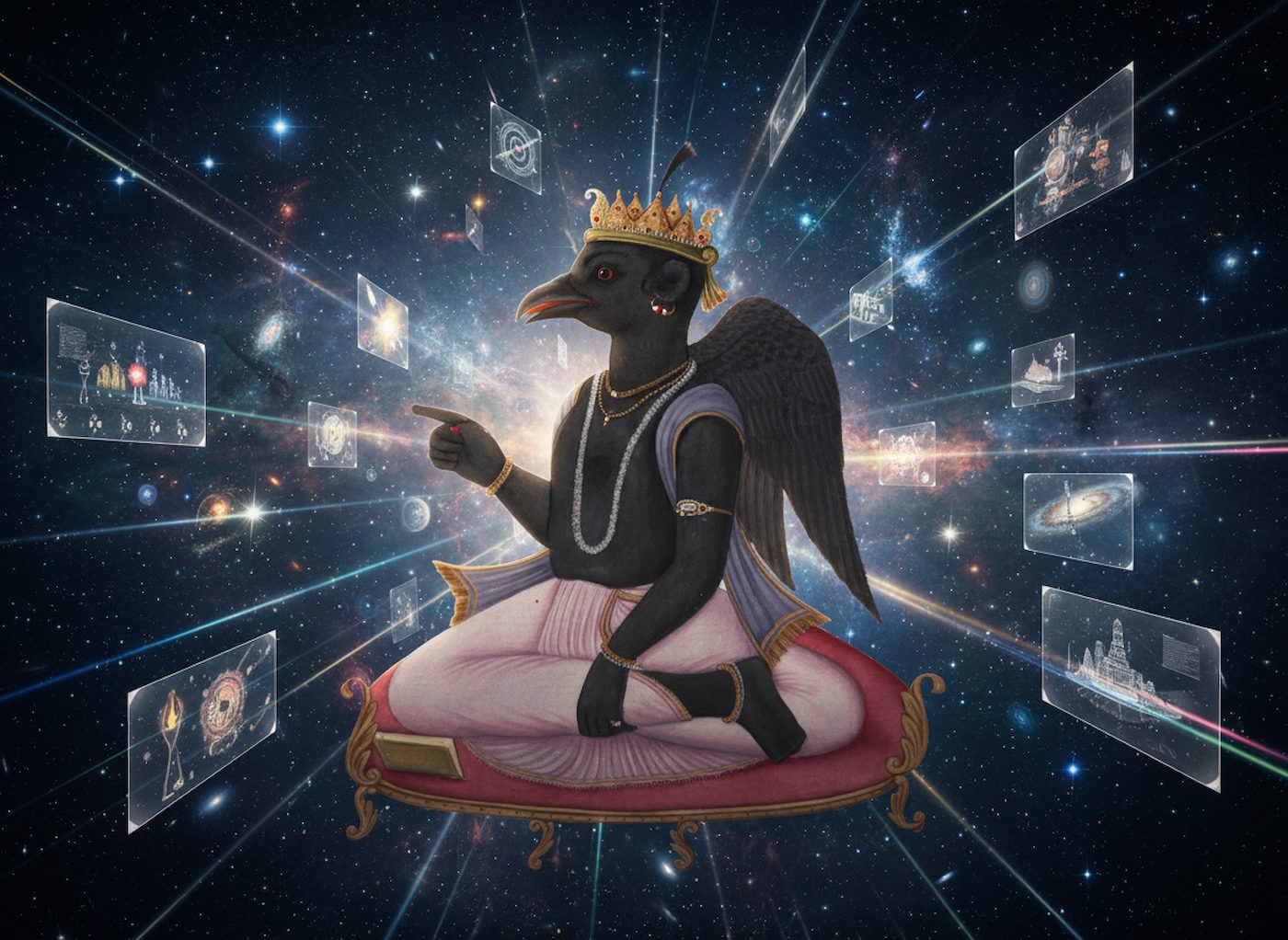
Hindu Dharma’s Multiverse Theory: How Kakabhushundi, the Eternal Crow, Witnessed Infinite Realities

Introduction: The Eternal Witness of Cosmic Cycles
In the vast ocean of Hindu cosmology, few figures embody the profound mysteries of time, space, and infinite realities as remarkably as Kakabhushundi. This immortal crow sage, whose name literally means “the crow who adorns himself” (काकभुशुण्डि), stands as one of the most extraordinary witnesses to the multiverse theory embedded within Hindu philosophy. While modern physics grapples with concepts of parallel universes and alternate timelines, the ancient Puranic narratives present Kakabhushundi as a being who has directly experienced countless iterations of cosmic creation and dissolution.
The story of Kakabhushundi challenges our linear understanding of existence. Unlike ordinary beings bound by the constraints of a single lifetime or even multiple rebirths within one cosmic cycle, this eternal crow has witnessed the Ramayana unfold not once, but innumerable times across different yugas and kalpas. His unique position in Hindu Dharma’s metaphysical framework offers us a window into the real multiverse—a concept that our scriptures explored millennia before contemporary scientists began proposing similar theories.
What makes Kakabhushundi particularly fascinating is that he represents the intersection of devotion and cosmic consciousness. Through his unwavering bhakti (devotion) to Lord Rama, he transcended the ordinary limitations of time and space, gaining the ability to perceive the Dharmic multiverse in its full glory. His narrative, primarily detailed in the Ramcharitmanas by Goswami Tulsidas and referenced in various Puranas, presents a sophisticated understanding of cosmic realities that resonates deeply with both traditional practitioners and modern seekers.
This article explores the profound wisdom embedded in the narrative of Kakabhushundi, examining how his experiences illuminate Hindu Dharma’s comprehensive multiverse theory. We will journey through the scriptural foundations of his story, analyze the philosophical implications of his eternal witness, and discover how this ancient teaching speaks to contemporary questions about the nature of reality itself.
The Sacred Origins of Kakabhushundi in Puranic Literature
The narrative of Kakabhushundi emerges from the rich Puranic narratives, specifically finding its most detailed exposition in Tulsidas’s Ramcharitmanas and references scattered throughout the Shiva Purana and other sacred texts. Unlike many figures in Hindu philosophy whose origins are clearly defined, Kakabhushundi’s story itself spans across multiple cosmic cycles, making his true beginning lost in the mists of eternal time.
According to the traditional accounts, Kakabhushundi was originally a devotee who, through a curse born of his pride, took birth as a crow. However, this apparent downfall became his greatest blessing. The form of the eternal crow granted him the ability to exist beyond the normal constraints of time, allowing him to witness the cosmic drama unfold repeatedly. This transformation illustrates a fundamental principle in Hindu cosmology: that what appears as misfortune in the limited perspective of human understanding may serve as a gateway to higher realization.
The Ramcharitmanas presents Kakabhushundi as the teacher of Garuda, the divine eagle and vehicle of Lord Vishnu. This reversal of the natural order—where a crow instructs an eagle—demonstrates the supremacy of spiritual wisdom over conventional hierarchies. When Garuda approaches Kakabhushundi seeking knowledge about Lord Rama’s divinity and the nature of reality, the eternal crow shares teachings that span countless lifetimes and multiple universal cycles.
In the Shiva Purana, we find references to Kakabhushundi as one who has pleased both Lord Shiva and Lord Rama through his devotion. The scriptures describe how he was granted the boon of immortality and the ability to witness the divine play (lila) of the Supreme across innumerable manifestations. This blessing positioned him uniquely within the Dharmic multiverse, allowing him to observe the same cosmic events unfold differently across various timelines and cosmic cycles.
The sacred narratives describe Kakabhushundi dwelling in the region of Ayodhya, specifically at Sugrīvaparvata, from where he maintains his eternal vigil. Unlike other immortal beings in Hindu philosophy such as the Chiranjīvis (seven immortals), Kakabhushundi’s immortality serves a specific purpose: he exists as the cosmic witness, the eternal observer who can testify to the unchanging nature of divine truth despite the constantly changing manifestations of reality.
Kakabhushundi’s position in the scriptural hierarchy is unique because he combines the humility of a simple crow with the wisdom of the most enlightened sages. His narrative teaches that true knowledge comes not from accumulating power or status but from surrendering to the divine will with complete devotion. Through his eyes, the Hindu multiverse theory becomes not merely an abstract philosophical concept but a living reality that he experiences directly.
Understanding the Dharmic Multiverse: Philosophical Foundations
The Hindu cosmology presents a sophisticated framework for understanding multiple realities that predates modern multiverse theories by millennia. This Dharmic multiverse is not a recent speculation but a fundamental aspect of Vedic and Puranic thought, deeply embedded in the metaphysical understanding of existence. Kakabhushundi’s experiences serve as practical evidence for this ancient wisdom.
At the foundation of this multiverse theory lies the concept of infinite kalpas (cosmic cycles). According to Hindu philosophy, creation and dissolution occur in endless repetition, with each kalpa lasting 4.32 billion years—a day in the life of Brahma, the creator deity. Kakabhushundi has witnessed not just one or two, but countless such cycles, each containing within it the complete progression through the four yugas: Satya, Treta, Dvapara, and Kali.
The Puranic narratives describe that within each kalpa, the cosmic realities manifest differently. While the essential divine truth remains constant—the avatars of Vishnu appear, dharma battles adharma, and the cosmic order is maintained—the specific details, characters, and circumstances vary. Kakabhushundi reports witnessing the Ramayana occur in subtly different ways across these cycles. Sometimes the events unfold with minor variations in how battles are fought, sometimes with different supporting characters, yet always maintaining the core essence of Rama’s divine mission.
This concept aligns with what Hindu philosophy calls the principle of “nānā vidham” (manifold diversity). The Upanishads teach that the One becomes many, and this becoming happens not just in space but also across time and dimensional realities. The eternal crow’s testimony supports this teaching, demonstrating that divine manifestation occurs in infinite variations while maintaining its essential nature.
The Vedantic perspective adds another layer to understanding the real multiverse. According to Advaita Vedanta, all these multiple realities exist simultaneously within the consciousness of Brahman, the ultimate reality. What appears as sequential cosmic cycles from the perspective of beings bound by time exists as a simultaneous whole in the timeless awareness of the Supreme. Kakabhushundi, having transcended ordinary temporal consciousness through his devotion, perceives both the sequential unfolding and the simultaneous existence of these realities.
The Bhagavad Gita provides scriptural support for this multiverse understanding when Lord Krishna reveals his Vishvarupa (cosmic form) to Arjuna. In Chapter 11, Krishna shows that within his divine form exist all beings, all times, all worlds—past, present, and future simultaneously. This revelation demonstrates that the Hindu multiverse theory is not speculative philosophy but revealed truth, accessible to those with the spiritual vision to perceive it.
Kakabhushundi’s narrative particularly emphasizes the role of consciousness in experiencing the Dharmic multiverse. The Puranic narratives describe how his elevated state of awareness allows him to perceive what remains hidden to ordinary beings. This suggests that the multiverse is not merely an external reality but is intimately connected with states of consciousness. Different levels of awareness grant access to different dimensions of reality—a concept that resonates with both traditional Hindu philosophy and contemporary theories about consciousness and reality.
Kakabhushundi’s Direct Experience of Infinite Ramayanas
Perhaps the most remarkable aspect of Kakabhushundi’s story is his firsthand testimony of having witnessed the Ramayana unfold countless times across different cosmic cycles. This experience forms the cornerstone of understanding how the eternal crow serves as evidence for the Hindu multiverse theory and the existence of infinite cosmic realities.
In his dialogue with Garuda, as recorded in the Ramcharitmanas, Kakabhushundi describes with profound reverence how he has observed Lord Rama’s incarnation occur repeatedly. Each time, the essential story remains constant: Rama takes birth as the son of King Dasharatha, lives in exile for fourteen years, defeats Ravana to rescue Sita, and establishes righteousness on earth. Yet within this consistent framework, Kakabhushundi notes variations in the details—different conversations, alternative sequences of events, and varied manifestations of the same fundamental truth.
The eternal crow explains that in some cosmic cycles, he observed the war with Lanka lasting different durations. In certain iterations, different warriors played more prominent roles. Sometimes the demon king Ravana’s brothers manifested with varying characteristics, yet the ultimate outcome—dharma’s victory over adharma—remained unchanging. This testimony reveals a profound principle: while the surface details of cosmic realities may vary, the underlying spiritual truth remains eternal and immutable.
Kakabhushundi’s description of witnessing these infinite Ramayanas serves multiple purposes in Hindu philosophy. First, it establishes the transcendent nature of divine avatars. Rama is not bound to a single historical manifestation but appears repeatedly across cosmic time, each appearance serving the eternal purpose of protecting dharma and destroying evil. The Puranic narratives emphasize that Rama’s divinity transcends any particular iteration of his story.
Second, the eternal crow’s testimony demonstrates the principle of “lila” (divine play) in its fullest sense. The Supreme Being engages in cosmic play across infinite stages, with infinite variations, yet always maintaining perfect consistency in upholding truth and righteousness. Kakabhushundi observes that despite having witnessed countless Ramayanas, his devotion never diminishes; instead, each viewing deepens his love and understanding of the divine mystery.
Third, this experience illustrates the nature of time in Hindu cosmology. For Kakabhushundi, time is not linear but cyclical and simultaneously multidimensional. He exists in a state where past, present, and future cosmic cycles are accessible to his consciousness. This aligns with the Upanishadic teaching that time itself is a modification of consciousness, not an absolute external reality.
The Ramcharitmanas presents a particularly moving episode where Kakabhushundi describes entering the mouth of the child Rama during one cosmic cycle. Inside, he witnesses the entire universe, including countless other Ramayanas occurring simultaneously in different regions of cosmic space. This vision within a vision demonstrates the fractal nature of the Dharmic multiverse—each level of reality contains within it infinite other levels, all sustained by the same divine consciousness.
Kakabhushundi shares with Garuda that in one particularly significant iteration, he questioned the reality of what he was witnessing. The eternal crow wondered whether these infinite variations meant that truth itself was relative. Lord Rama then granted him a vision showing that all these manifestations arise from one unchanging source—the Supreme Reality that is beyond name and form. This teaching reconciles multiplicity with unity, showing that the real multiverse exists within the One without contradicting its absolute nature.
The eternal crow also describes how his perspective on devotion evolved through witnessing these countless Ramayanas. Initially, he was attached to the specific form and story he knew. But through repeated observation across cosmic cycles, he came to understand that true bhakti transcends any particular manifestation. His devotion became focused on the eternal principle that Rama represents—the Supreme Being who protects, guides, and liberates all beings across all realities.
Time Travel in Hindu Dharma: Beyond Linear Chronology
The narrative of Kakabhushundi introduces concepts that modern physics categorizes as time travel, yet Hindu philosophy has embedded such ideas within its cosmological framework for millennia. The eternal crow’s ability to witness events across multiple cosmic cycles represents a sophisticated understanding of temporal mechanics that transcends our ordinary perception of linear time.
In Hindu cosmology, time operates on multiple scales simultaneously. The Puranic narratives describe various measurements of cosmic time, from the briefest paramanu (atomic moment) to the vast duration of a kalpa. Kakabhushundi exists outside this ordinary temporal framework while simultaneously being able to observe and interact within it. This paradoxical position illustrates what the scriptures call “kālātīta” (beyond time) consciousness—a state achieved through supreme devotion and divine grace.
The concept of time travel in Hinduism differs fundamentally from modern science fiction portrayals. Rather than physical movement backward or forward along a temporal line, Hindu philosophy describes time as a circular or spiral pattern of cosmic cycles. Kakabhushundi doesn’t travel through time in the conventional sense; instead, his consciousness transcends temporal boundaries, allowing him to perceive multiple timeframes simultaneously. This aligns with the Yogic concept of “trikāla-jñāna” (knowledge of three times), where advanced yogis can perceive past, present, and future as a unified whole.
The Bhagavata Purana provides additional context for understanding time in the Dharmic multiverse. It describes how time itself is a śakti (power) of the Supreme Being, created to regulate the cosmic manifestation. For beings under the influence of māyā (cosmic illusion), time appears as a linear progression of moments. But for those who have transcended māyā through devotion or realization—like Kakabhushundi—time reveals its true nature as a circular, multidimensional phenomenon.
Kakabhushundi’s testimony reveals that in the eternal present of divine consciousness, all cosmic cycles exist simultaneously. What appears as sequential from the conditioned perspective occurs concurrently in the unconditioned reality. This understanding bridges ancient wisdom with contemporary physics, which proposes that at the quantum level, time may not flow in the linear fashion we experience macroscopically.
The eternal crow describes to Garuda how he has observed not just sequential cosmic cycles but also parallel manifestations of similar events. In some accounts, he mentions witnessing different versions of the same cosmic period occurring in different lokas (planes of existence) simultaneously. This suggests a multidimensional temporal structure where time operates differently across various levels of cosmic reality—a concept that resonates with theories of time dilation and relative simultaneity in modern physics.
The scriptures present Kakabhushundi’s relationship with time as fundamentally rooted in his devotion. The Ramcharitmanas emphasizes that his ability to transcend temporal limitations came not from yogic practices or mystical techniques but from pure love for Lord Rama. This teaching suggests that in Hindu Dharma, consciousness—particularly devotional consciousness—represents the key to accessing different temporal and dimensional realities within the real multiverse.
Another fascinating aspect of time travel Hinduism presents through Kakabhushundi is the concept of witnessing rather than intervention. Unlike many fictional time travel narratives where travelers alter past events, the eternal crow purely observes. He cannot and does not change what unfolds, because from the highest perspective, everything occurs according to divine will and cosmic law (ṛta). This limitation illustrates the principle that while consciousness can transcend time, the cosmic order remains inviolate.
The Vedantic interpretation of Kakabhushundi’s temporal transcendence points to an even deeper truth: that time itself is ultimately unreal from the absolute perspective. All events—past, present, and future—exist as modifications within the eternal consciousness of Brahman. Kakabhushundi’s experience of multiple cosmic cycles represents not travel through real time but the awakening to time’s illusory nature, recognizing that all temporal manifestations are simultaneous expressions of the timeless reality.
Cosmic Realities and the Architecture of Existence
Kakabhushundi’s testimony provides unprecedented insight into the structure of cosmic realities as understood in Hindu philosophy. His direct observation of multiple universal cycles reveals an architecture of existence far more complex and magnificent than conventional understanding suggests. The Dharmic multiverse, as witnessed by the eternal crow, operates according to principles that integrate metaphysics, theology, and what we might today call quantum cosmology.
The Puranic narratives describe the cosmos as consisting of fourteen lokas or planes of existence, arranged in a hierarchical yet interconnected structure. These include seven higher worlds (Bhūrloka, Bhuvarloka, Svarloka, Maharloka, Janarloka, Tapoloka, and Satyaloka) and seven lower worlds (Atala, Vitala, Sutala, Talātala, Mahātala, Rasātala, and Pātāla). Kakabhushundi’s unique position allows him to observe how events in one loka influence and mirror occurrences in others, revealing the interconnected nature of these cosmic realities.
What makes Kakabhushundi’s perspective particularly valuable is his description of how the same divine principles manifest differently across these various planes. He observes that Lord Rama’s avatara occurs not just in Bhūrloka (the earthly plane) but reverberates through all levels of existence. The cosmic realities respond to this divine incarnation, each according to its own nature and dharmic function. This demonstrates that the Hindu multiverse theory encompasses not just parallel timelines but also parallel dimensional spaces, each with its own laws and characteristics.
The eternal crow describes witnessing multiple Brahmāndas (cosmic eggs or universes) existing simultaneously. Each Brahmānda contains its own set of fourteen lokas, its own cycle of creation and dissolution, and its own manifestations of divine avatars. The Brahma Vaivarta Purana supports this cosmology, stating that innumerable universes float in the causal ocean (Kārana Sāgara) like bubbles, each presided over by its own Brahma, Vishnu, and Shiva.
Kakabhushundi’s narrative reveals that these multiple universes aren’t isolated from each other but exist in a state of subtle interconnection. Events in one universe can create ripples affecting others, though the precise mechanics of this interaction remain within the mystery of divine lila. The eternal crow mentions that in rare moments of heightened spiritual vision, he has perceived the boundaries between universes becoming transparent, revealing the underlying unity of all cosmic realities.
The architecture of existence that Kakabhushundi describes includes the concept of kāla-chakra (the wheel of time) operating at different speeds in different cosmic realities. Time in the heavenly lokas flows differently than in earthly realms, and differently still in the lower worlds. This relativistic understanding of time predates Einstein’s theories by thousands of years, presenting a sophisticated cosmological model where temporal flow varies according to the gravitational and spiritual density of different planes.
In Hindu philosophy, these cosmic realities aren’t merely physical spaces but states of consciousness. Each loka corresponds to a particular level of spiritual awareness and karmic development. Kakabhushundi’s ability to witness across these multiple realities stems from his consciousness having expanded beyond the limitations of any single plane. His devotion to Rama serves as the key that unlocks access to these various dimensions of the Dharmic multiverse.
The eternal crow also describes the role of vibration (spanda) and sound (nāda) in structuring cosmic realities. The Vedic concept of creation through primordial sound (Om or Pranava) finds practical illustration in Kakabhushundi’s observations. He witnesses how different mantric vibrations generate and sustain different cosmic planes, each universe essentially a crystallization of specific divine frequencies. This understanding aligns remarkably with modern string theory, which proposes that fundamental particles are vibrating strings.
Kakabhushundi reveals that within this vast architecture of cosmic realities, certain beings like himself, the devas (celestial beings), and other immortals can traverse between planes. However, such movement isn’t arbitrary but governed by spiritual qualification, karmic merit, and divine permission. The real multiverse operates according to strict dharmic principles, ensuring cosmic order despite its infinite complexity.
The Philosophy of Eternal Return and Cosmic Cycles
Central to understanding Kakabhushundi’s experience is the Hindu philosophical concept of eternal return—the idea that cosmic creation and dissolution occur in endless cycles, with patterns repeating across vast temporal scales. The eternal crow’s testimony provides living proof of this ancient doctrine, showing how the same divine dramas unfold repeatedly while maintaining both consistency and variation.
The doctrine of eternal return in Hindu Dharma differs significantly from the ancient Greek concept proposed by philosophers like Nietzsche. In Hindu cosmology, the repetition isn’t exact duplication but rather a rhythmic recurrence of fundamental patterns, similar to how waves in an ocean are both similar and unique. Kakabhushundi observes that each cosmic cycle (kalpa) maintains the essential structure—the progression through yugas, the incarnation of avatars, the battle between dharma and adharma—yet manifests with infinite variations in detail.
This understanding connects to the concept of “nitya-līlā” (eternal play) described in the Bhagavata Purana. The Supreme Being’s divine activities are simultaneously historical events that occurred in time and eternal occurrences happening continuously in the transcendent realm. Kakabhushundi’s unique perspective allows him to witness both aspects: the temporal unfolding in various cosmic cycles and the eternal present where all līlās exist simultaneously.
The Puranic narratives describe the cycle of creation (sṛṣṭi), maintenance (sthiti), and dissolution (pralaya) operating at multiple scales. A minor dissolution (naimittika pralaya) occurs at the end of Brahma’s day, when the lower fourteen lokas are temporarily withdrawn. A major dissolution (prākṛta pralaya) happens at the end of Brahma’s lifetime of 100 divine years, when the entire manifest universe returns to its causal state. Kakabhushundi has witnessed countless such dissolutions and subsequent re-creations, each time observing how the cosmic patterns re-establish themselves.
What Kakabhushundi finds most remarkable is the precision with which these cycles operate. The eternal crow describes to Garuda how the cosmic law (ṛta) ensures that despite apparent chaos and infinite variations, certain fundamental patterns never deviate. The avatars always appear when dharma declines, the righteous always ultimately triumph, and the cosmic order always reasserts itself. This mathematical precision in cosmic cycles suggests an underlying intelligence governing the Dharmic multiverse.
The philosophy of eternal return also addresses a profound theological question: if the Supreme Being is all-knowing, why does creation repeat? Why do souls undergo countless cycles of birth and death? Kakabhushundi’s answer, drawn from direct observation, is that these cycles serve as opportunities for spiritual evolution. Each cosmic cycle offers innumerable souls the chance to progress toward liberation, with those who achieve moksha in one cycle transcending the wheel of repeated existence.
The eternal crow observes that while the cosmic cycles repeat for the universe as a whole, individual souls don’t necessarily experience identical lifetimes across different kalpas. A soul’s karma from one cycle influences but doesn’t rigidly determine its trajectory in subsequent cycles. This introduces an element of genuine freedom and unpredictability within the larger pattern of cosmic determinism—a sophisticated solution to the age-old philosophical problem of free will versus predestination.
Kakabhushundi notes that certain liberated beings, like himself, exist across multiple cycles by choice rather than karmic compulsion. Their presence serves specific purposes in the cosmic economy—teaching, witnessing, or serving as channels for divine grace. This voluntary participation in the eternal return distinguishes liberated beings from those bound by karmic necessity, illustrating different modes of existing within the cycling cosmic realities.
The concept of yugas (cosmic ages) within each kalpa adds another layer of complexity to the eternal return. Each cycle progresses through Satya Yuga (golden age), Treta Yuga, Dvapara Yuga, and Kali Yuga (iron age), with dharma progressively declining. Kakabhushundi has witnessed this pattern repeat countless times, yet he observes that the speed and specifics of decline vary across different cosmic cycles. Some Kali Yugas descend more rapidly into darkness; others show pockets of sustained dharmic practice. This variation within pattern exemplifies how the Dharmic multiverse balances law with freedom.
Devotion as the Gateway to Multiverse Consciousness
Perhaps the most transformative aspect of Kakabhushundi’s story is his teaching that supreme devotion (bhakti) serves as the ultimate gateway to experiencing the real multiverse. Unlike scientific or philosophical approaches that rely on intellectual analysis or technological advancement, the path Kakabhushundi demonstrates is fundamentally devotional—grounded in love for the divine rather than mere curiosity about cosmic mechanisms.
The eternal crow’s spiritual journey began not with seeking knowledge of the multiverse but with single-pointed devotion to Lord Rama. The Ramcharitmanas describes how his bhakti was so pure and intense that it transcended the limitations of his crow form, granting him vision beyond ordinary perceptual boundaries. This teaching emphasizes a crucial principle in Hindu philosophy: consciousness, when purified and concentrated through devotion, can access dimensions of reality unavailable to the analytical mind.
Kakabhushundi explains to Garuda that his ability to witness countless cosmic cycles emerged naturally from his unwavering focus on Rama’s divine nature. He didn’t perform complex yogic practices or austere penances specifically aimed at gaining cosmic vision. Rather, his love for Rama was so complete that all barriers between his individual consciousness and the cosmic consciousness dissolved, revealing the multilayered nature of existence.
This devotional approach to multiverse consciousness aligns with the teaching of the Bhagavad Gita, where Krishna declares that through bhakti, devotees come to know the Supreme in truth. Kakabhushundi’s experience demonstrates that this knowledge isn’t merely intellectual understanding but direct perception—a living awareness of the infinite manifestations of divine reality across all cosmic planes and temporal cycles.
The Puranic narratives emphasize that Kakabhushundi’s devotion possessed certain key characteristics that made it effective as a spiritual practice. First, it was “niṣkāma” (desireless)—he loved Rama not for gaining powers or knowledge but purely for the joy of devotion itself. Second, it was “ananya” (exclusive)—his heart remained undistracted by other pursuits or attractions. Third, it was “dṛḍha” (firm)—unchanging despite any circumstances or across countless lifetimes.
The eternal crow teaches that this quality of devotion creates a unique state of consciousness he calls “prema-dṛṣṭi” (vision of love). Through prema-dṛṣṭi, a devotee perceives the divine presence pervading all realities, all times, all beings. This loving vision transforms one’s relationship with the cosmos from that of an external observer studying separate phenomena to an intimate participant recognizing the beloved in every manifestation. Kakabhushundi sees Rama not just in the historical prince of Ayodhya but in every cosmic cycle, every loka, every being.
What makes devotion particularly powerful as a gateway to multiverse consciousness, according to Kakabhushundi, is that it operates through grace rather than personal effort alone. The eternal crow acknowledges that his abilities come not from his own merit but from Rama’s kripa (compassion). This grace-centered approach distinguishes the devotional path from purely yogic or intellectual methods, suggesting that the deepest secrets of cosmic realities are revealed rather than discovered—gifted by the divine to those whose hearts are open.
Kakabhushundi also addresses a common misunderstanding: that his multiverse vision makes him detached from the present moment or indifferent to current reality. He clarifies that quite the opposite is true. Witnessing infinite cosmic realities heightens his appreciation for each moment, each manifestation, each expression of divine play. His devotion doesn’t lead to cosmic escapism but to deeper engagement with every level of existence, recognizing each as a precious opportunity for serving and loving the divine.
The eternal crow describes how his bhakti evolved through witnessing countless Ramayanas. Initially, he was attached to specific forms and narratives. But gradually, he came to perceive the unifying essence behind all variations—the eternal principle of divine love, protection, and righteousness that Rama embodies. This evolution from form-bound devotion to essence-oriented bhakti represents the maturation of spiritual consciousness, moving from multiplicity to unity without negating the reality of diverse manifestations.
In teaching Garuda, Kakabhushundi emphasizes that access to multiverse consciousness through devotion isn’t reserved for extraordinary beings like himself. Any sincere devotee can begin experiencing expanded awareness of cosmic realities by cultivating pure love for the divine. The depth of vision correlates with the intensity and purity of devotion rather than with intellectual capacity or social position. This democratization of spiritual access reflects Hinduism’s fundamental principle that the ultimate truth is available to all sincere seekers, regardless of external qualifications.
Kakabhushundi’s Teachings on Reality, Illusion, and Truth
Through his unique position as witness to infinite cosmic realities, Kakabhushundi offers profound teachings on the nature of reality, the function of māyā (cosmic illusion), and the relationship between multiplicity and ultimate truth. His insights synthesize experiential wisdom with traditional Vedantic philosophy, providing a comprehensive framework for understanding existence.
The eternal crow begins by addressing what appears as a paradox: if he has witnessed countless variations of the same cosmic events, which version is “real”? His answer revolutionizes conventional thinking about reality. Kakabhushundi teaches that all manifestations are simultaneously real and illusory—real in the sense that they genuinely occur within the cosmic play, illusory in that they represent temporary expressions of an eternal underlying truth.
This perspective aligns with the Advaita Vedantic concept of “vyāvahārika satya” (empirical reality) and “pāramārthika satya” (absolute reality). The various cosmic cycles and their infinite variations exist within the empirical realm, governed by laws of cause and effect, karma, and divine will. Yet from the absolute perspective, they are waves on the ocean of Brahman—temporarily arising, existing, and subsiding without disturbing the eternal consciousness that is their source.
Kakabhushundi explains that māyā functions as the divine creative power that generates this multiplicity within unity. Rather than viewing māyā as a negative force creating deception, he describes it as the Supreme Being’s śakti (power) through which the formless manifests in infinite forms. The real multiverse exists because māyā possesses inexhaustible capacity for variation, allowing the One to appear as many without ever actually dividing or diminishing.
The eternal crow offers a particularly illuminating teaching about the relationship between observer and observed in the Dharmic multiverse. He notes that his consciousness doesn’t exist separately from the cosmic realities he witnesses. The observer, the act of observation, and the observed phenomena all arise within the same universal consciousness. This non-dual understanding dissolves the subject-object duality that usually structures human perception, revealing a more fundamental mode of knowing.
Kakabhushundi addresses the question of why the Supreme Being creates multiple variations of the same cosmic drama. His answer draws on the concept of līlā—divine play undertaken for the sheer joy of expression. Just as an artist creates multiple variations on a theme or a musician improvises endless variations on a melody, the Supreme Being manifests infinite cosmic realities as an expression of creative bliss (ānanda). Each variation offers new opportunities for different souls, different expressions of devotion, different manifestations of beauty and grace.
The eternal crow also teaches about the practical implications of understanding reality’s multidimensional nature. He suggests that recognizing the multiplicity of cosmic realities cultivates both detachment and engagement—detachment from rigid beliefs that any single manifestation represents the complete truth, and engagement with the present moment as a precious expression of divine creativity. This balanced perspective prevents both nihilistic rejection of the world and naive literalism.
One of Kakabhushundi’s most subtle teachings concerns what he calls “satya-dṛṣṭi” (vision of truth). This capacity to perceive truth doesn’t mean seeing only one reality as real while dismissing others as false. Rather, it means recognizing the underlying truth that unifies all manifestations. In every Ramayana he witnesses, despite variations in details, Kakabhushundi perceives the same essential truth: divine love protecting dharma and guiding beings toward liberation. This consistent essence forms the unchanging core within infinite variations.
The eternal crow explains that illusion (māyā) operates at the level of identification rather than manifestation. The cosmic realities themselves aren’t illusions; what’s illusory is the belief that any particular manifestation represents ultimate or independent reality. When consciousness identifies with temporary forms and fails to recognize their source in eternal Being, illusion binds. When consciousness recognizes all forms as expressions of the formless, illusion serves its proper function as the creative power of manifestation.
Kakabhushundi shares with Garuda that his witnessing of infinite cosmic cycles has confirmed a fundamental Vedantic teaching: that consciousness itself is the only constant reality. Bodies change, worlds change, even universes arise and dissolve, but the awareness that witnesses all these changes remains unchanged. This witnessing consciousness—called sākṣi or dṛk in Vedantic terminology—represents the true self of every being, identical with the universal consciousness that sustains all cosmic realities.
The eternal crow also addresses the relationship between free will and determinism within the real multiverse. He observes that while cosmic patterns follow regular laws and cycles repeat according to divine will, individual souls possess genuine freedom in their responses to circumstances. This freedom creates the variations he observes across different cosmic cycles—the same karmic situations may elicit different choices, leading to subtly different outcomes. Thus the multiverse accommodates both cosmic order and individual agency.
Scientific Resonance: Ancient Wisdom Meets Modern Physics
The narrative of Kakabhushundi presents striking parallels with contemporary physics and cosmology, particularly theories about multiverses, quantum mechanics, and the nature of time. While Hindu philosophy developed these concepts within a spiritual and metaphysical framework, modern science arrives at remarkably similar conclusions through empirical investigation—a convergence that suggests fundamental truths about reality may be accessible through multiple pathways.
The multiverse theory in modern physics proposes that our universe may be one among many, possibly infinite, universes existing simultaneously. The eternal crow’s testimony of witnessing countless Brahmāndas (cosmic eggs) floating in the causal ocean presents an ancient formulation of this same concept. Kakabhushundi’s description of universes arising, existing, and dissolving like bubbles parallels contemporary cosmological models of universe formation and the anthropic principle.
Quantum mechanics introduces concepts that would have seemed mystical a century ago but that Hindu philosophy has taught for millennia. The observer effect in quantum physics—where observation influences the state of quantum systems—resonates with Kakabhushundi’s teaching that consciousness and cosmic reality are intimately interconnected. The eternal crow’s ability to perceive multiple cosmic realities simultaneously suggests a consciousness operating beyond the classical physics framework, accessing what quantum theory might describe as a superposition of states.
The concept of time in Kakabhushundi’s narrative aligns remarkably with Einstein’s relativity, which demonstrated that time isn’t absolute but relative to the observer’s reference frame. The eternal crow’s description of time flowing differently in various lokas predates Einstein by millennia, presenting a sophisticated understanding of temporal relativity within the Dharmic multiverse. His ability to exist outside ordinary temporal flow while observing events within it suggests consciousness can transcend the spacetime continuum—a concept that both mysticism and cutting-edge physics find increasingly plausible.
String theory in modern physics proposes that fundamental particles are actually vibrating strings, and different vibration patterns create different particles and forces. Kakabhushundi’s description of creation through primordial sound and different mantric vibrations generating different cosmic planes presents a strikingly similar model. The Vedic concept of nāda (cosmic sound) as the fundamental creative force parallels string theory’s emphasis on vibration as the basis of material reality.
The Hindu cosmological understanding of cyclical time—with cosmic cycles of creation and dissolution—finds echoes in cosmological models like the cyclic universe theory and the Big Bounce hypothesis. These modern theories propose that our universe may undergo repeated cycles of expansion and contraction, similar to the Hindu concepts of pralaya (cosmic dissolution) and sṛṣṭi (creation) that Kakabhushundi has witnessed countless times.
However, it’s crucial to recognize that while these parallels are fascinating, Hindu philosophy and modern science approach reality from fundamentally different starting points and with different goals. Science seeks empirically verifiable, mathematically describable models of physical phenomena. Hindu Dharma integrates physical cosmology within a larger framework addressing consciousness, purpose, ethics, and liberation. Kakabhushundi’s testimony serves spiritual ends—deepening devotion and understanding of divine nature—rather than merely satisfying intellectual curiosity about cosmic mechanics.
The eternal crow’s experience also addresses what contemporary physics calls the “hard problem of consciousness”—explaining how subjective experience arises from physical processes. Hindu philosophy doesn’t view this as a problem because it begins with consciousness as primary, with physical reality emerging from consciousness rather than the reverse. Kakabhushundi’s ability to witness across multiple cosmic realities demonstrates consciousness operating independently of any particular physical substrate, suggesting it represents a fundamental aspect of existence rather than an emergent property of matter.
Recent developments in quantum information theory explore how information might be fundamental to reality—a perspective that resonates with the Vedic concept of cosmic intelligence (cit) underlying all manifestation. Kakabhushundi’s description of consistent patterns repeating across cosmic cycles suggests an informational substrate—what Hindu philosophy calls the akashic records or cosmic memory—that transcends individual universe cycles.
The concept of holographic universe theory—proposing that our three-dimensional reality may be a projection from information encoded on a two-dimensional surface—finds a parallel in Kakabhushundi’s description of entering child Rama’s mouth and witnessing infinite universes within. This nested, fractal structure of reality, where each part contains information about the whole, aligns with both ancient Vedic cosmology and contemporary physics speculations.
While we should avoid simplistic conflation of ancient spiritual teachings with modern scientific theories, the resonances between Kakabhushundi’s multiverse testimony and contemporary physics suggest that both may be describing authentic aspects of reality through different languages and methodologies. The convergence points toward a more comprehensive understanding that integrates the objective measurements of science with the subjective insights of contemplative wisdom.
Practical Spiritual Lessons from the Eternal Witness
Beyond its cosmological and philosophical significance, Kakabhushundi’s narrative offers profound practical guidance for spiritual seekers navigating contemporary life. The eternal crow’s experiences translate into actionable wisdom that addresses universal human concerns about meaning, purpose, and liberation within the vast cosmic context.
The first major lesson Kakabhushundi teaches is the cultivation of detached engagement. Having witnessed countless cosmic cycles where civilizations rise and fall, empires emerge and crumble, even universes manifest and dissolve, he maintains neither cynical disengagement nor anxious attachment. Instead, he participates fully in each moment while recognizing its temporary nature within the eternal flow. This balanced perspective helps contemporary practitioners avoid both nihilistic despair and neurotic clinging, engaging meaningfully with life while maintaining spiritual perspective.
Kakabhushundi emphasizes that his witnessing of infinite variations of the Ramayana hasn’t diminished his devotion but rather deepened it. This teaches that true bhakti doesn’t depend on ignorance or naivety but can withstand—and actually flourish through—expanded awareness of reality’s complexity. Modern seekers often struggle with doubts when their understanding of religion grows more sophisticated; the eternal crow models how deepening knowledge can coexist with and enhance devotional practice.
The eternal crow’s humility despite his cosmic knowledge offers crucial guidance for spiritual practitioners. Though he possesses awareness spanning countless universes and infinite time, Kakabhushundi maintains the demeanor of a simple devotee, always ready to serve and learn. This teaches that spiritual advancement isn’t measured by accumulated knowledge or extraordinary experiences but by the quality of one’s devotion and character. In contemporary spiritual communities often plagued by ego inflation, this lesson proves particularly valuable.
Kakabhushundi’s emphasis on nama-sankirtana (chanting divine names) as central to his practice provides accessible spiritual technology for modern practitioners. He teaches that the divine name carries the complete essence of cosmic reality, making elaborate knowledge of multiverse mechanics unnecessary for spiritual progress. Simply chanting Rama’s name with devotion grants access to the same ultimate truth that his vast cosmic vision reveals. This democratizes spiritual attainment, removing it from the exclusive domain of scholars or mystics.
The eternal crow addresses a concern particularly relevant to contemporary seekers: how to maintain spiritual enthusiasm and freshness when practices become routine. His answer draws from witnessing the same divine drama countless times yet finding each iteration fresh and moving. He explains that repetition becomes monotonous only when consciousness remains superficial. When awareness deepens, even the most familiar reveals infinite depth and newness. This teaching encourages practitioners to approach daily spiritual practices with fresh attention rather than mechanical habit.
Kakabhushundi’s narrative also offers perspective on suffering and adversity. Having observed how cosmic patterns repeat with dharma always ultimately triumphing, he teaches that temporary difficulties serve larger purposes within the cosmic order. This doesn’t justify passivity in the face of injustice but provides the long-term perspective needed to persevere through challenges without losing faith. For contemporary practitioners facing personal or collective crises, this cosmic context provides resilience.
The eternal crow emphasizes the importance of satsang (spiritual company) and guru-seva (service to teachers). His entire narrative emerges from teaching Garuda, demonstrating how sharing spiritual wisdom serves both teacher and student. Kakabhushundi models how advanced practitioners should make their knowledge accessible to sincere seekers, breaking down barriers between “enlightened” and “ordinary” beings. This teaching counters elitist tendencies in spiritual communities, emphasizing transmission and service.
Another practical lesson concerns the integration of spiritual understanding with ordinary life. Kakabhushundi doesn’t withdraw from the world despite his cosmic awareness. He remains engaged with creation, serving divine purposes while maintaining internal freedom. This teaches that enlightenment doesn’t require renunciation of engagement but transformation of the consciousness with which one engages. Modern practitioners seeking to integrate spirituality with careers, relationships, and social responsibilities find guidance in this model.
The eternal crow’s teaching about accepting one’s role within the cosmic whole offers medicine for contemporary individualism’s diseases. Kakabhushundi recognizes he serves a specific function within divine economy—witnessing and teaching—and fulfills this role without desiring to be something else. This acceptance of one’s dharma (duty/nature) while serving larger purposes beyond personal gratification provides an alternative to both ego-driven ambition and purposeless drift.
Finally, Kakabhushundi teaches the practice of continuous remembrance (smarana) of the divine. His consciousness remains constantly focused on Rama regardless of what cosmic events unfold around him. This unbroken awareness, cultivated through practice, eventually becomes effortless and natural. For modern practitioners whose attention fragments across countless demands and distractions, this teaching offers a path to integration: gradually training the mind to maintain awareness of the sacred while performing all activities.
The Eternal Crow in Comparative Spiritual Traditions
While Kakabhushundi’s narrative emerges specifically from Hindu Puranic literature, examining parallel figures and concepts in other spiritual traditions illuminates both universal patterns and unique aspects of the Dharmic multiverse understanding. Such comparison enriches appreciation for the eternal crow’s significance while respecting the distinctiveness of different traditions.
In Buddhist cosmology, we find the concept of Avalokiteshvara or Chenrezig—the bodhisattva of compassion who perceives the suffering of beings across countless worlds and works for their liberation. Like Kakabhushundi, Avalokiteshvara maintains awareness spanning multiple cosmic realms and time periods. However, while the eternal crow primarily serves as witness and teacher, the bodhisattva actively intervenes to alleviate suffering. This difference highlights how Hindu philosophy emphasizes divine līlā unfolding according to cosmic law, while Mahayana Buddhism stresses the bodhisattva’s compassionate action within that unfolding.
The Jain tradition presents the concept of Tirthankars and liberated souls (Siddhas) who have transcended time and karma while maintaining awareness of cosmic processes. These beings, like Kakabhushundi, exist beyond ordinary temporal flow while perceiving the workings of karma and universal law. The Jain emphasis on infinite kevala-jnana (omniscient knowledge) possessed by liberated beings parallels the eternal crow’s cosmic vision, though Jain philosophy typically focuses more on the mechanics of karma than on devotional relationship with the divine.
In Abrahamic traditions, we find figures like the prophet Enoch, who according to biblical and apocryphal texts was granted visions of heaven, multiple worlds, and divine secrets. The Book of Enoch describes his journeys through celestial realms and visions of cosmic history—experiences that share thematic similarities with Kakabhushundi’s multiverse witnessing. However, Abrahamic monotheism’s linear conception of time (with creation having a definite beginning and history progressing toward an end) contrasts with the cyclic cosmology central to Kakabhushundi’s narrative.
Sufi mysticism offers the concept of the “Perfect Human” (al-Insan al-Kamil) whose consciousness mirrors the divine, containing knowledge of all worlds and times. Certain Sufi saints are described as experiencing fana (annihilation of the ego) and baqa (subsistence in God), states where ordinary limitations of perspective dissolve. While the theological framework differs, this mystical expansion of consciousness resonates with how Kakabhushundi’s devotion enables perception beyond normal boundaries.
The figure of Merlin in Western esoteric traditions—particularly in versions where he experiences time backward or accesses knowledge of past and future—offers another interesting parallel. However, the Western magical tradition typically frames such abilities as attained through occult practice or supernatural gift, whereas Kakabhushundi explicitly teaches that his vision emerges from devotional surrender rather than mystical technique.
Chinese Daoist philosophy’s concept of immortals (xian) who transcend normal limitations and perceive the Dao’s workings across cosmic scales shares certain similarities with the eternal crow. However, Daoist cosmology’s emphasis on spontaneous natural processes (ziran) and wu-wei (non-action) differs from Hindu philosophy’s integration of divine will, karma, and dharma that frames Kakabhushundi’s understanding.
What distinguishes Kakabhushundi within this comparative landscape is the specifically devotional character of his realization. Many traditions describe cosmic vision or transcendence of time through meditation, asceticism, or esoteric practice. The eternal crow uniquely demonstrates that pure devotional love itself—without deliberate mystical technique—opens awareness to the real multiverse. This teaching reflects bhakti tradition’s central assertion: that the heart’s surrender accomplishes what the mind’s effort cannot.
Another distinctive aspect is Kakabhushundi’s explicit focus on witnessing multiple iterations of the same divine narrative rather than progressing through stages toward culmination. Most traditions frame spiritual development linearly: the soul advances from ignorance to knowledge, from bondage to liberation. The eternal crow’s experience of cyclic repetition presents an alternative framework where spiritual depth comes not from linear progression but from perceiving the eternal truth within infinite temporal manifestations.
The eternal crow’s narrative also uniquely combines individual realization with cosmic scope. Many mystical accounts describe either personal transformation or cosmic vision, but rarely both integrated so thoroughly. Kakabhushundi’s story demonstrates how personal devotion to Rama and awareness of infinite cosmic realities mutually reinforce rather than contradict each other—a synthesis particularly characteristic of Hindu philosophy’s non-dual approach.
Kakabhushundi’s Message for the Modern Age
As we navigate the complexities of the twenty-first century—with its unprecedented technological advancement, existential challenges, and spiritual confusion—Kakabhushundi’s ancient wisdom offers remarkably relevant guidance. The eternal crow’s perspective on cosmic realities, time, and devotion speaks directly to contemporary concerns about meaning, purpose, and our place within an increasingly vast and mysterious universe.
In an age when scientific discoveries continually expand our understanding of cosmic scale—revealing billions of galaxies, each containing billions of stars, with potentially countless planets supporting life—Kakabhushundi’s testimony that he has witnessed infinite universes provides spiritual context for this overwhelming magnitude. Rather than making human existence seem insignificant, his teaching suggests that consciousness capable of witnessing and understanding this vastness participates in something profound. The very capacity to contemplate the multiverse indicates consciousness transcending material limitations.
Modern society’s obsession with novelty and progress receives challenging perspective from the eternal crow’s observation of fundamental patterns repeating across cosmic cycles. Kakabhushundi witnesses that despite countless variations in details, the essential truths remain constant: dharma ultimately prevails, devotion leads to realization, and divine grace operates throughout creation. This teaching doesn’t advocate complacency but rather grounds progressive action in awareness of timeless principles that transcend particular historical moments.
The contemporary environmental crisis—where human activity threatens planetary ecosystems—gains sobering context from Kakabhushundi’s witnessing of countless world dissolutions. While this might seem to justify environmental nihilism (“worlds come and go anyway”), the eternal crow actually teaches the opposite. Precisely because he has seen worlds destroyed and renewed, he appreciates each manifestation as precious, each being as worthy of care. His cosmic perspective enhances rather than diminishes responsibility toward current reality.
In an era of fragmented attention and information overload, Kakabhushundi’s practice of single-pointed devotion offers powerful medicine. The eternal crow demonstrates that depth of focus on one divine principle (Rama) grants access to universal truth more effectively than superficial engagement with countless subjects. This teaching challenges contemporary assumptions that more information and broader knowledge necessarily lead to wisdom, suggesting instead that profound engagement with one authentic spiritual path may prove more transformative than spiritual eclecticism.
The modern anxiety about mortality and the meaning of individual existence receives compassionate address in Kakabhushundi’s narrative. Having witnessed countless beings across infinite cosmic cycles, he confirms that individual lives possess genuine significance within the larger pattern. Each soul’s journey, each act of devotion, each expression of dharma contributes to the cosmic whole. Simultaneously, his teaching that consciousness transcends bodily death—continuing across lifetimes and even cosmic cycles—provides framework for engaging mortality without denial or debilitating fear.
Contemporary science’s exploration of multiverse theories and quantum mechanics creates unprecedented opportunity for dialogue between scientific and spiritual worldviews. Kakabhushundi’s narrative, articulating multiverse concepts within devotional framework, models how scientific understanding and spiritual wisdom can complement rather than contradict each other. His teaching suggests that empirical investigation and contemplative insight represent different but potentially compatible paths toward understanding reality’s multidimensional nature.
The eternal crow’s emphasis on nama-sankirtana (chanting divine names) as sufficient spiritual practice addresses modern seekers’ confusion amid overwhelming options. Contemporary spiritual marketplace offers countless techniques, systems, and paths—often generating more confusion than clarity. Kakabhushundi’s simple prescription—devotional chanting of Rama’s name—cuts through complexity, offering accessible practice that supposedly accomplishes what elaborate systems promise. This democratization of spiritual attainment challenges both consumerist spirituality and elite mysticism.
In addressing contemporary social fragmentation and polarization, Kakabhushundi’s teaching about seeing the same divine essence across different manifestations proves particularly relevant. Having witnessed the Ramayana unfold in countless variations, he recognizes that diverse expressions can embody identical truth. This perspective encourages appreciation for diversity while maintaining conviction in universal principles—a balance crucial for pluralistic societies struggling to honor both difference and commonality.
The eternal crow’s story also speaks to contemporary psychology’s insights about trauma, memory, and identity. His witnessing of cosmic cycles without being psychologically overwhelmed suggests a mode of consciousness that maintains equilibrium despite exposure to vast suffering and repeated loss. This resilience emerges not from dissociation but from grounding identity in the eternal (his relationship with Rama) rather than the temporary. Such teaching offers framework for processing both personal and collective trauma without losing hope or purpose.
Finally, Kakabhushundi’s narrative addresses what many identify as the defining challenge of our age: finding meaning and purpose when traditional frameworks have dissolved and postmodern skepticism questions all grand narratives. The eternal crow doesn’t offer naive certainty or dogmatic answers. Instead, he models how direct experiential encounter with the divine—accessible through devotional practice—can ground life in authentic meaning that transcends both naive literalism and cynical relativism. His testimony suggests that the deepest truths aren’t believed but witnessed, not argued but experienced.
Conclusion: The Eternal Witness and Our Spiritual Journey
The narrative of Kakabhushundi stands as one of Hindu Dharma’s most profound teachings on the nature of reality, consciousness, and devotion. Through this eternal crow’s unique perspective—spanning countless cosmic cycles, witnessing infinite manifestations of divine līlā, and maintaining unwavering bhakti despite cosmic vastness—we receive wisdom that addresses both timeless spiritual questions and contemporary existential concerns.
What emerges most powerfully from Kakabhushundi’s story is the integration of cosmic scope with intimate devotion. The same being who witnesses infinite universes arising and dissolving maintains the tender heart of a simple devotee, loving Rama with personal intensity. This synthesis challenges false dichotomies between the universal and particular, the cosmic and personal, philosophical understanding and devotional surrender. The eternal crow demonstrates that true wisdom encompasses both infinite awareness and intimate relationship.
Kakabhushundi’s testimony confirms central teachings of Hindu philosophy while offering fresh perspective on them. The concepts of māyā, karma, dharma, and moksha receive illumination through his direct observation across multiple cosmic realities. His experience validates that these aren’t merely theoretical constructs or metaphorical teachings but describe actual operations of consciousness and cosmos. The real multiverse exists, governed by principles our scriptures have articulated for millennia.
Yet despite—or perhaps because of—his vast knowledge, Kakabhushundi emphasizes the supremacy of simple devotion. Having witnessed countless cosmic cycles and comprehended the mechanics of universal manifestation, he teaches that pure love for Rama represents the essence and goal of all spiritual seeking. This teaching protects against two common spiritual errors: mistaking intellectual understanding for realization, and devaluing knowledge in favor of anti-intellectual pietism. The eternal crow models integration: profound understanding serving and enriching devotion.
For contemporary practitioners navigating modernity’s spiritual challenges, Kakabhushundi offers multiple gifts. His story provides cosmological framework that accommodates scientific discoveries while maintaining spiritual meaning. His practice demonstrates accessible methods—primarily nama-sankirtana—that don’t require extensive learning or special circumstances. His character models humility, service, and continuous growth despite advanced realization. His teaching balances cosmic perspective with engagement in present reality.
The eternal crow’s witnessing across infinite cosmic realities ultimately points toward the One reality underlying all manifestations. Whether Ramayana unfolds in Treta Yuga or Kali Yuga, in this universe or countless others, the same divine principle operates. Recognizing this unity within multiplicity represents Kakabhushundi’s deepest teaching: that the Dharmic multiverse exists within the consciousness of Brahman, and through devotion, individual consciousness can recognize its identity with that ultimate awareness.
As we conclude this exploration of Kakabhushundi’s wisdom, we might reflect on how his narrative invites us to reconsider our own experience. Perhaps the linear, limited perspective we normally inhabit represents just one mode of consciousness—potentially expandable through spiritual practice. Perhaps the cosmic patterns the eternal crow witnesses operate even within our individual lives, with essential truths repeating across different circumstances. Perhaps devotion truly does offer the key to unlocking dimensions of reality currently hidden from our awareness.
Kakabhushundi’s story ultimately affirms the deepest promise of Hindu Dharma: that consciousness is infinite, reality is multidimensional, and liberation is achievable. Whether we personally witness countless Ramayanas across infinite universes matters less than whether we cultivate the quality of devotion that made such witnessing possible for the eternal crow. In the end, his message proves beautifully simple: love the divine completely, serve with humility, and trust that grace will reveal whatever needs revealing.
ॐ तत्सत् ब्रह्मार्पणमस्तु
Om Tat Sat Brahmarpanam-astu
“Om, may this offering be to the Absolute Truth, to Brahman”

Comments are closed.